AI governance is failing for most organizations. Despite $35–40 billion in generative AI investments, only 5% of companies scale their AI projects successfully. The main reasons? Misaligned goals, unclear ownership, and outdated workflows. These issues lead to wasted budgets, compliance risks, and shadow AI usage by 90% of employees.
Key findings from the MIT report include:
- Misaligned budgets: Over 50% of AI spending goes to front-office tasks, but back-office automation delivers better ROI.
- Ownership gaps: 72% of leaders say teams need clear rules, but centralization often causes delays.
- Workflow issues: AI tools fail when forced into rigid processes, as shown by high failure rates of internal projects (67% succeed with external vendors vs. 33% in-house).
To fix governance, companies must:
- Align AI projects with business goals and measurable KPIs.
- Redesign workflows to integrate AI effectively.
- Assign clear ownership for every initiative.
- Conduct regular audits for performance and compliance.
The takeaway? Success in AI requires more than tools - it demands smarter governance tied to real business outcomes.
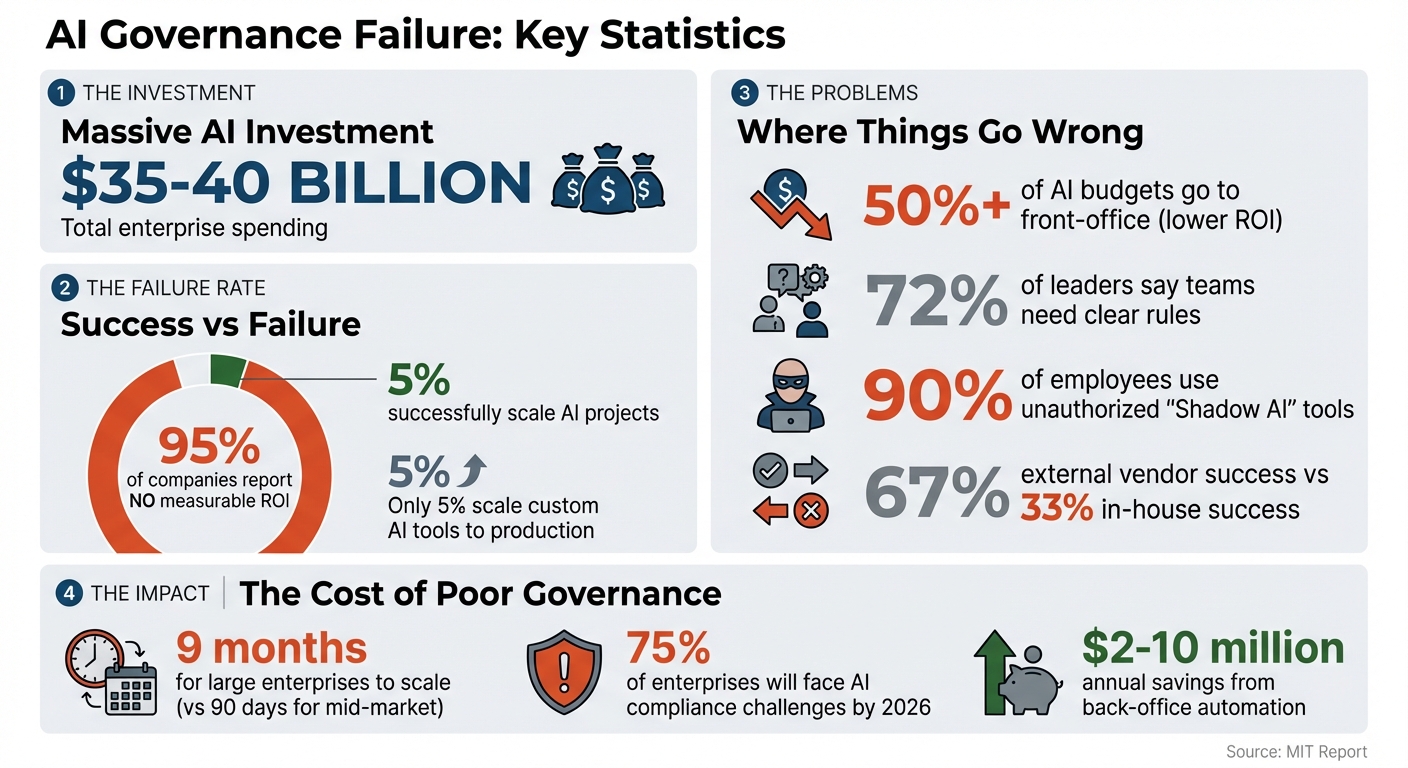
AI Governance Failure Statistics: Investment vs Returns
The 95% Problem: Fixing What’s Broken in Enterprise AI | 116
Why AI Governance Fails: Key Findings
MIT highlights three main reasons for the failure of AI governance: misaligned goals, unclear ownership, and unchanged workflows. Let’s dive into each issue to understand where things go wrong.
AI Projects Don't Align with Business Goals
One of the biggest hurdles is the disconnect between AI initiatives and actual business objectives. Many companies pour more than 50% of their AI budgets into front-office operations like sales and marketing. However, the most substantial returns often come from automating back-office tasks such as document processing and procurement. This misallocation means that while productivity might see a boost, these efforts rarely translate into meaningful improvements to the bottom line.
The numbers back this up: nearly all generative AI (GenAI) pilot projects fail to show measurable ROI. Why? Because these pilots often focus on peripheral or experimental challenges rather than addressing core business needs. Without tackling real problems, these projects struggle to adapt, evolve, or deliver sustained value.
Lack of Clear Ownership and Accountability
A major stumbling block for AI governance is the absence of defined ownership. While some organizations establish centralized AI roles or centers of excellence, the lack of clarity often creates bottlenecks. A survey reveals that 72% of business leaders believe corporate headquarters should set broad guidelines, but individual teams should define the specific rules for using AI.
Robert C. Pozen, Senior Lecturer at MIT Sloan School of Management, explains the issue:
"Centralization creates bottlenecks. Teams wait for approval, workarounds proliferate, and some employees play it safe by circumventing AI productivity tools instead of harnessing them."
This accountability gap becomes even more apparent during procurement. AI projects sourced externally succeed 67% of the time, compared to just 33% for those developed in-house. Without clear accountability, internally built tools often fail to deliver.
AI Implementation Without Workflow Overhaul
Simply adding AI tools to existing workflows without rethinking processes often leads to inefficiency and frustration. When AI systems are forced into outdated, rigid workflows, they become little more than ineffective add-ons that employees eventually abandon.
Real-world examples from fintech and healthcare show the importance of integrating AI into redesigned workflows. For instance, in 2025, fintech company dLocal successfully deployed a generative AI Assistant platform. Guido Lonetti, Head of Product, emphasized that achieving true AI impact requires a complete reimagining of daily operations. Similarly, emtelligent, a medical NLP company, processed 5.1 billion medical notes and boosted structured biomarker data by 80% by embedding AI directly into clinical workflows. As CEO Dr. Tim O'Connell observed:
"The real barriers to AI in healthcare mirror other technology predecessors like CRM and EHR in that they are organizational, not technological."
These examples underline the importance of redesigning workflows to unlock AI's full potential. Organizations that succeed in AI governance empower teams to take the lead, foster external partnerships, and ensure accountability that ties directly to business outcomes.
What Failed Governance Costs Companies
The lack of proper AI governance is hitting companies where it hurts most - financially. Businesses have poured an estimated $30–$40 billion into generative AI, yet a staggering 95% of organizations report no measurable returns on these investments. This points to wasted budgets, missed opportunities, inefficiencies, and growing compliance risks.
Zero Returns on AI Spending
The numbers paint a stark picture. Although 80–90% of companies have adopted AI in some form, only a small fraction - just 5% - have successfully scaled custom AI tools into full production. Many projects remain stuck in endless pilot phases, draining resources without delivering results. Misaligned budgets further exacerbate the issue, as funds often flow toward initiatives with minimal returns.
That said, there are exceptions. Successful back-office AI implementations have saved some companies between $2 million and $10 million annually by reducing their reliance on external business process outsourcing. Highlighting the broader challenge, MIT researcher Aditya Challapally remarked:
"The 95% failure rate for enterprise AI solutions represents the clearest manifestation of the GenAI Divide".
Shadow AI and Compliance Risks
When official AI tools fail to meet expectations, employees often take matters into their own hands. Around 90% of employees use personal AI tools for work, even though only 40% of companies have invested in enterprise-grade AI subscriptions. This rise of "Shadow AI" introduces serious security and compliance risks, leaving existing governance frameworks scrambling to keep up.
The inefficiencies aren’t just technical - they’re organizational. Large enterprises, bogged down by complex governance processes, can take up to nine months to transition from pilot projects to full-scale implementation. Compare that to mid-market firms, which typically achieve the same in just 90 days. This "enterprise paradox" highlights how resource-rich companies often struggle to turn their advantages into measurable outcomes.
These gaps in governance call for a complete overhaul of AI workflows and accountability structures. Tackling these financial and compliance challenges is essential for creating a more effective approach to AI governance.
sbb-itb-34a8e9f
How to Fix AI Governance
To fix AI governance, it’s essential to align policies with day-to-day operations. The MIT report emphasizes that successful organizations don’t just adopt AI - they fundamentally rethink how work gets done around it. Here’s how companies can bridge the gap between AI investments and meaningful results.
Build Governance That Aligns with Business Goals
AI governance often fails when it’s disconnected from business objectives. Instead of chasing vague innovation goals, focus on specific, measurable targets tied to departmental needs. For instance, aim for something tangible like "reduce document processing time by 40%" rather than a broad goal like "explore AI opportunities."
Cross-functional oversight is key. Create a governance committee that includes representatives from Legal, IT, HR, and Compliance to ensure AI initiatives align with company values and meet regulatory standards. This is especially important as regulatory scrutiny increases - by 2026, 75% of enterprises are expected to face AI-related compliance challenges.
Additionally, hold vendors accountable for delivering results that meet your business metrics, not just technical performance. As the MIT report highlights, many organizations settle for generic, off-the-shelf AI tools that don’t fully address their unique needs. Push for customized solutions and tie vendor contracts to measurable KPIs, such as reducing business process outsourcing costs or cutting agency spending.
Once governance is tied to business goals, the next step is to embed AI into workflows that are purposefully redesigned for efficiency.
Redesign Workflows Around AI Tools
Governance alignment is only the beginning - true transformation requires rethinking workflows. Adding AI to inefficient processes only amplifies existing problems. Instead, standardize and document core business processes before introducing AI. This includes eliminating manual handoffs and addressing "tribal knowledge" that can hinder scalability.
A great example of this approach is Guardian Life Insurance. Between 2025 and 2026, the company used AI-driven automation to overhaul its RFP and quoting process. By doing so, it reduced turnaround time from about a week to just 24 hours. To support this shift, the CTO reorganized teams into small, cross-functional groups focused on specific products and platforms, leveraging APIs to speed up delivery.
Focus on narrow, high-impact workflows where returns are easier to measure. Back-office functions like document processing, procurement, and contract management often deliver clearer and faster ROI compared to broader, front-office applications.
Assign Clear Ownership for Each AI Initiative
Workflow redesign works best when paired with clear leadership for every AI project. According to the MIT report, 72% of business leaders believe individual teams should set their own rules for AI usage, while corporate leadership provides overarching guidelines. Assigning specific roles ensures accountability at the team level, where decisions and execution take place.
High-performing AI organizations are three times more likely to have senior leaders who visibly champion AI adoption. Guido Lonetti, Head of Product at dLocal, underscores this idea:
"Every leader at dLocal must make a mindset shift, re-imagining their day-to-day work through the lens of AI".
Assign distinct roles for each initiative, such as Data Stewards to oversee data quality, Algorithm Auditors to evaluate performance, and Compliance Officers to ensure regulatory alignment. Empower line managers and "power users" to lead AI adoption within their teams. This reduces the need for constant central approvals, which can create bottlenecks and drive employees toward unsanctioned "shadow AI" solutions.
Run Regular Audits and Decision Sprints
Static governance doesn’t work in a dynamic environment. Replace it with regular audits and structured decision-making processes. Schedule periodic reviews to assess whether AI outputs remain fair, accurate, and aligned with business goals. Use these reviews to make clear Stop/Start/Scale decisions based on operational outcomes - not sunk costs or internal politics.
Take inspiration from HRbrain’s ROI Reset Sprint, which provides a 5-day audit to determine Stop/Start/Scale actions, followed by a 30-day implementation plan. Their process includes a 3-week sprint to redesign workflows from end to end, turning strategy into measurable results.
Documentation is critical. Maintain a detailed record of model versions, policy updates, and the reasoning behind AI-driven decisions. This "paper trail" becomes invaluable during audits and regulatory reviews, especially as frameworks like the EU AI Act and GDPR continue to evolve.
Conclusion: Making Governance Work
AI governance often falters when it’s approached as just another compliance task. According to the MIT report, weak governance is a key reason why one in four AI projects fails. On the flip side, companies with strong governance frameworks see real benefits - 27% higher efficiency gains and 34% higher operating profits from their AI efforts. The takeaway? The solution isn’t piling on more rules; it’s about executing smarter.
The numbers tell an even clearer story. Organizations with mature governance systems are 81% more likely to involve their CEOs in decision-making around AI. High-performing companies are also three times more likely to have senior leaders who actively advocate for AI adoption. Instead of relying on endless committees, these companies appoint decision-makers who are empowered to greenlight, pause, or even retire AI projects based on how well they deliver business results.
Another shift that’s proving essential is moving away from static, one-size-fits-all policies to systems that allow for continuous monitoring. AI evolves quickly - quarterly reviews just can’t keep up. Leading companies are adopting real-time tracking of model performance, maintaining detailed documentation of version histories and decision-making prompts, and giving teams the authority to halt projects the moment risks exceed acceptable thresholds.
To make governance truly effective, it needs to be woven into the fabric of daily workflows rather than treated as an afterthought. This could mean redesigning processes before introducing AI, holding vendors accountable for operational performance instead of just technical specs, and targeting specific, high-impact automations where results can be clearly measured. As the MIT report highlights, the biggest obstacle to scaling AI isn’t a lack of infrastructure or talent - it’s the ability to learn and adapt.
The data reveals a common thread among the 95% of companies reporting no ROI from their AI investments: they treat governance as a one-and-done effort. Turning this around requires a focused approach - auditing current AI spending, making clear Stop/Start/Scale decisions tied to business outcomes, and deploying redesigned workflows with defined ownership and measurable KPIs. When done right, governance stops being a bottleneck and becomes a catalyst for better performance.
FAQs
Why do AI governance efforts often fail in businesses?
AI governance often stumbles because businesses often treat AI as a side project rather than embedding it into their core operations. According to the MIT 2025 State of AI in Business report, a major problem is that many AI tools remain static - they don’t adapt or improve over time. Instead of becoming dynamic systems that learn and evolve, they end up as stagnant "science projects." This creates a learning gap, where tools fail to incorporate feedback or grow smarter through use.
Another hurdle is the poor alignment of AI systems with existing business processes. Companies often bolt AI onto their workflows without rethinking or redesigning them, which makes scaling nearly impossible. While 80-90% of businesses experiment with AI pilots, only about 5% manage to transition these initiatives into full-scale production.
Other challenges include low user trust, the rise of shadow AI (unapproved AI tools used by employees), and a tendency to prioritize flashy front-office applications over high-return back-office automation. Together, these issues make it difficult for companies to achieve measurable results from their AI investments.
How can businesses ensure their AI projects deliver real value?
Many businesses find it challenging to see meaningful returns from their AI investments because their projects often remain isolated experiments instead of becoming part of their core operations. The MIT 2025 State of AI in Business report highlights this issue, stating that 95% of generative AI initiatives fail to deliver measurable ROI. The primary reasons? Poor integration into workflows, lack of accountability, and weak governance structures.
To improve outcomes, companies need to take a structured approach. Start by setting clear goals - whether it's boosting revenue, cutting costs, or improving productivity - and tie these goals to specific AI performance metrics. From there, redesign workflows to leverage AI capabilities effectively, ensuring the technology is central to the process rather than an afterthought. It's also crucial to establish strong governance and accountability with clear ownership and decision-making processes. This helps AI initiatives transition into scalable, production-ready systems that consistently deliver measurable results.
Platforms like HRbrain can play a key role in this transformation. These tools help organizations pinpoint gaps in their AI adoption, revamp workflows, and integrate AI solutions with well-defined KPIs to optimize ROI.
Why is workflow redesign critical for achieving ROI from AI investments?
Workflow redesign plays a critical role in translating AI investments into tangible business results. One common pitfall for many companies is simply layering AI tools onto existing processes without rethinking how tasks are executed. To truly harness the power of AI, workflows need to be reimagined - this means automating repetitive tasks, delivering real-time insights, and creating seamless transitions for human decision-makers. When AI is woven into every step of the process, its potential is fully realized.
This kind of redesign also brings structure and clarity to AI initiatives. By identifying bottlenecks, breaking down data silos, and setting measurable KPIs, organizations can ensure that their AI efforts align with overarching business objectives. Strong leadership and fostering a culture where employees embrace these changes are equally important for success. Without this shift, AI investments risk falling into the alarming statistic from MIT’s State of AI in Business report, which found that 95% of AI projects fail to deliver measurable returns.