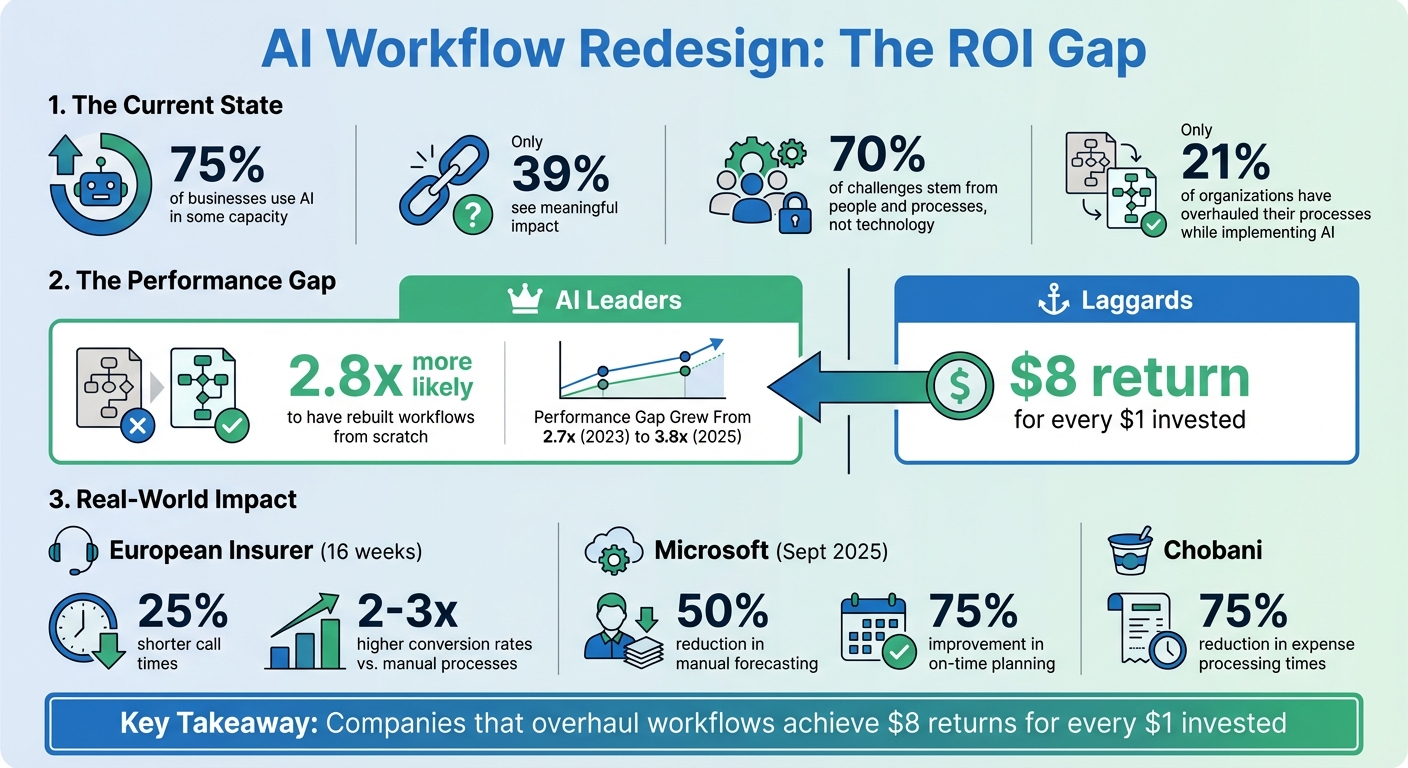
AI investments often fail to deliver financial results because companies layer advanced tools onto outdated processes instead of rethinking workflows. Here's the issue: while 75% of businesses use AI in some capacity, only 39% see meaningful impact. The solution? Redesigning workflows to fully integrate AI, not just deploying tools in isolation.
Key takeaways:
- Why AI Adoption Falls Short: 70% of challenges stem from people and processes, not the technology itself.
- Workflow Redesign = ROI: Companies that overhaul workflows achieve $8 returns for every $1 invested.
- Common Barriers: Inefficiencies in sales, finance, and operations prevent AI from reaching its potential.
- HRbrain’s Solution: Sprint-based services to audit spending, redesign workflows, and deliver measurable ROI in months, not years.
To see results, businesses must treat AI as a driver of transformation, not a quick fix. Companies excelling in AI prioritize end-to-end process changes, achieving faster ROI and outperforming competitors.
AI Workflow Redesign ROI Statistics and Impact Comparison
How Workflow Redesign Drives ROI
Why Workflows Must Change for AI to Work
To get real value from AI, businesses need to rethink their workflows entirely. Right now, only 21% of organizations have overhauled their processes while implementing AI. The rest are just layering AI on top of outdated systems, which limits its potential.
According to McKinsey, high-performing companies are 2.8 times more likely to have rebuilt their workflows from scratch. Between 2023 and 2025, the performance gap between AI leaders and those lagging behind has grown from 2.7x to 3.8x. What sets the leaders apart? They focus on redesigning whole processes to harness AI capabilities instead of just picking models. This mindset helps companies achieve returns like $8 for every $1 invested, while others struggle to break even.
"An average model with great engineering beats a great model with average engineering." – Merelda Wu, Melio AI
These top companies don’t just deploy AI in isolated tools like chatbots. Instead, they transform end-to-end processes, from the start of a customer interaction to fulfillment and servicing. Take the example of a European insurer: within 16 weeks, they restructured their commercial operations around a network of AI agents. The result? 25% shorter call times and conversion rates that were 2 to 3 times higher than manual processes.
By reimagining workflows, these companies address the common obstacles that prevent AI from reaching its full potential.
Common Workflow Barriers in Mid-Market Companies
For mid-market companies, outdated workflows often block AI from delivering meaningful returns. Let’s break it down by function:
- Sales: Many teams operate with parallel structures where commercial and operations units duplicate efforts, creating inefficiencies. Legacy CRM systems are another hurdle - they follow rigid, step-by-step processes designed for human handoffs. This setup doesn’t take advantage of AI’s ability to process tasks in parallel, leaving cycle times unchanged.
- Finance: Data fragmentation is a major issue. AI struggles to reconcile discrepancies like "Acme Corp" versus "Acme Inc." across systems, leading to incomplete data and flawed forecasts. Zillow’s experience in November 2021 is a cautionary tale. Its "Zestimate" AI relied too heavily on structured data, such as square footage, while ignoring unstructured factors like neighborhood trends. The result? A $500 million loss and layoffs affecting 25% of its workforce.
- Operations: Poor performance measurement undermines ROI. Companies often claim productivity gains without tracking hard data on cycle times, error rates, or revenue. Without this, it’s impossible to prove AI’s impact. Adding to the challenge, much of a company’s critical information - emails, call transcripts, contracts - exists in unstructured formats. If workflows aren’t redesigned to integrate this data, AI can’t access or use it effectively.
"Today, AI is bolted on. But to deliver real impact, it must be integrated into core processes, becoming a catalyst for business transformation rather than a sidecar tool." – Arthur Mensch, CEO, Mistral AI
Stop Bolting On AI and Redesign Processes for 4× ROI
HRbrain's Sprint-Based Solutions for AI ROI
HRbrain addresses workflow inefficiencies with a focused approach, offering two specialized sprints designed to turn AI investments into measurable returns. Instead of simply adding tools, these sprints focus on redesigning workflows for maximum impact. As Derick Do puts it:
"AI ROI is strongest when you redesign workflows, not when you add a new tool".
These sprints aim to speed up the ROI timeline. While 85% of organizations are increasing AI investments, many take two to four years to see returns - far longer than the expected seven to 12 months. HRbrain’s method compresses this timeline by auditing spending, making Stop/Start/Scale decisions, and delivering redesigned workflows with accountability built in.
5-Day ROI Reset Sprint
This sprint, priced between $9,500 and $12,500, starts with a detailed audit of AI expenditures. It identifies which initiatives to stop, start, or scale, linking each use case to key business drivers such as revenue growth, cost reduction, risk management, or improved experiences. The outcome is a 30-day execution plan to launch a redesigned workflow with clear ownership and defined KPIs.
By setting baseline metrics, the ROI Reset Sprint avoids the common "95% measurement trap" and translates financial impact into terms CFOs trust, like Net Present Value (NPV) and Internal Rate of Return (IRR).
3-Week Workflow Transformation Sprint
Priced between $18,000 and $28,000, this sprint focuses on redesigning two complete workflows. It includes detailed implementation specs, playbooks, and KPIs, addressing challenges like the 74% talent gap and the integration issues that affect 38% of mid-market firms.
The sprint delivers playbooks that align workflows with human practices, focusing on connected sequences rather than isolated tasks. As Kweilin Ellingrud explains:
"The real productivity unlock comes from reimagining workflows so people, agents, and robots each do what they do best".
The result? Production-ready workflows with clear accountability and measurable metrics, including cycle time, cost per transaction, and revenue lift.
sbb-itb-34a8e9f
Roadmap for Workflow Redesign and ROI
How to Identify High-Impact Use Cases
Mid-market companies often stumble by focusing on standalone AI tools instead of creating interconnected systems that can give them a competitive edge. A better approach is to target broader domains - clusters of 4–5 related business activities like software development, B2B sales, or claims processing. Bain & Company explains it well:
"ROI comes from reimagining how work gets done and how a company competes. And that requires something deeper: business redesign with AI at the core".
Start by identifying a clear business objective - whether it’s cutting costs, driving revenue, or reducing risks. Then, apply the Four Levers diagnostic to evaluate your current workflows:
- Eliminate unnecessary meetings and repetitive tasks.
- Synchronize data flows across different teams or systems.
- Streamline processes to focus on decision-critical inputs.
- Automate manual tasks by digitizing them.
This approach highlights areas where AI can make a substantial difference, rather than just offering small, incremental improvements.
For instance, in September 2025, Microsoft cut manual forecasting by 50% and improved on-time planning by 75%. Similarly, Chobani revamped its financial workflows, reducing expense processing times by 75% and enabling the finance team to focus more on strategic tasks.
To measure ROI effectively, set an 8–12-week baseline for key metrics like processing times, error rates, or revenue per transaction. Use tools such as NPV, IRR, and payback period to calculate the financial impact. Without this groundwork, many AI investments risk falling into the trap of delivering no measurable returns.
Once high-impact use cases are identified, the next step is to implement redesigned workflows efficiently.
Implementing Redesigned Workflows
Successful implementation starts with zero-based process design. This means mapping out the current state (your "point of departure") and envisioning the future state (your "point of arrival") where AI is fully integrated into workflows, rather than just layered onto existing processes. A two-in-the-box approach - where business and tech leaders collaborate - ensures solutions are both technically sound and aligned with business goals.
To embed AI effectively, tasks should be categorized into two groups:
- Discovery tasks: These include creative efforts like research or drafting ideas. AI excels here, as the cost of errors is low and the potential for generating new ideas is high.
- Trust tasks: These involve areas like credit risk or compliance, where mistakes can be costly. Human oversight is critical in these scenarios.
Currently, AI agents perform well on simple, single-step tasks, achieving a 58% success rate. However, for complex, multi-step interactions, this drops to 35%.
Real-world examples illustrate the impact of this approach. In September 2025, Nestlé eliminated paper-based expense processes using AI, completely removing manual management and tripling employee efficiency in creating reports. SA Power Networks deployed an AI system to manage aging infrastructure, saving $1 million in a year and achieving a 99% success rate in identifying corroded utility poles.
To maximize the benefits of reclaimed time, redirect these efficiency gains toward high-value activities. For example, use the time saved to increase monthly proposal volumes by 25. Regularly track adoption rates and monitor performance post-deployment to refine AI systems and strengthen the case for ongoing investments.
Involving employees in transformation efforts is also critical. Research shows that engaging at least 7% of the workforce in these initiatives can double the likelihood of achieving positive shareholder returns. Ultimately, this isn’t just a tech upgrade - it’s a complete business overhaul. Success depends on executive leadership, well-defined KPIs, and accountability systems built into performance evaluations.
Conclusion
Treating AI as just another tech upgrade rather than a full-scale business transformation is where many companies stumble. While a striking 88% of businesses use AI in at least one function, only 33% manage to scale it beyond the pilot phase. The real game-changer isn’t the AI model itself - it’s how workflows are designed to support and integrate it.
For mid-market companies, waiting 2–4 years to see a return on investment isn’t an option, especially when competitors are achieving payback in just 6–12 months. The solution lies in rethinking processes from the ground up. This means mapping out current workflows, cutting out outdated processes that drain 20–30% of effort, and reimagining operations with AI embedded at the center. This is exactly the approach HRbrain champions.
HRbrain tackles these challenges with focused sprints designed to speed up transformation. These sprints audit AI spending, help identify what to stop, start, or scale, and ensure redesigned workflows are implemented with clear KPIs and accountability.
The companies seeing 3–4 times the impact of their competitors aren’t just using better AI models - they’re fundamentally reengineering their workflows and weaving AI into the fabric of their business operations. This is how mid-market companies can turn AI from a buzzword into real, measurable results.
FAQs
Why is redesigning workflows critical to achieving ROI from AI investments?
Integrating AI into business operations isn't just about adopting cutting-edge technology - it’s about rethinking how work gets done. Despite enterprises pouring $30–40 billion into AI annually, a staggering 95% of companies fail to see a clear return on investment. Why? Because AI is often treated as a bolt-on feature rather than being woven into the fabric of reengineered workflows.
When workflows are thoughtfully redesigned, AI becomes more than a tool for isolated tasks - it aligns with overarching business objectives. This approach establishes clear governance, accountability, and measurable KPIs, ensuring AI outputs directly contribute to profit-driving metrics. By embedding AI into end-to-end processes, businesses can move past stalled pilots and start achieving results that scale.
HRbrain focuses on helping mid-market leaders pinpoint these gaps and implement tailored solutions, paving the way for measurable ROI and sustainable growth.
What challenges prevent AI from delivering measurable ROI?
Many organizations encounter recurring obstacles that prevent AI from reaching its full potential. First, businesses often pour resources into AI tools without rethinking their workflows. This leaves the technology stuck in isolated pilot projects instead of being woven into impactful, data-driven operations. Second, the absence of clear governance, accountability, and measurable KPIs makes it tough to gauge AI’s effectiveness, leading to unclear returns on growing investments. Third, challenges like limited access to skilled professionals, expensive infrastructure, and long implementation timelines can make adopting AI seem unattainable - especially for mid-sized companies. Finally, resistance to change and low employee adoption rates further slow progress, leaving many organizations unable to move beyond experimentation.
HRbrain helps mid-market leaders tackle these challenges by reimagining workflows, setting up governance frameworks, and providing teams with the tools and accountability they need to transition from small-scale pilots to scalable, ROI-focused AI solutions.
How can businesses accurately measure the ROI of AI workflow redesigns?
To effectively measure the ROI of AI-driven workflow redesigns, start by linking each AI initiative to a clear business objective. Whether the goal is to cut costs, boost revenue, or enhance efficiency, this alignment ensures the redesign has a purpose. Begin by establishing a baseline for the current process - think labor hours, error rates, or cycle times - and set measurable KPIs to gauge progress. For instance, track metrics like the percentage reduction in manual work or dollar savings per transaction. Assign accountability by designating ownership and embedding data collection and KPI tracking into the revamped workflow.
When calculating ROI, compare the financial benefits of the redesign - such as cost savings or revenue increases - against its total costs, which include development, integration, and ongoing monitoring. A simple ROI formula like ((Benefits - Costs) ÷ Costs × 100) works well. Additionally, consider long-term metrics like net present value (NPV) to capture the redesign's extended impact. Keep an eye on KPIs over time and share results, such as quarterly EBIT gains, to highlight the value delivered.
To validate results, use controlled experiments or before-and-after comparisons to isolate the redesign's effect. For example, if a $500,000 redesign leads to a $2 million cut in processing costs, that’s a 300% ROI - a clear win. By directly tying outcomes to business goals, companies can confidently demonstrate measurable success and build a strong case for further AI investments.