Most companies investing in AI aren’t seeing the returns they expected. Despite billions spent - $30–$40 billion annually - 95% of businesses report no measurable ROI from generative AI. Why? It’s not the technology itself but how it’s implemented. Companies often layer AI onto outdated processes, misallocate budgets, and neglect the human and organizational shifts required for success.
Key takeaways:
- Long ROI Timelines: AI payback takes 2–4 years, far longer than other tech investments.
- Workflow Redesign Matters: High-performing companies are 3x more likely to rebuild workflows around AI.
- Leadership Gaps: Only 26% of companies have a Chief AI Officer, yet those that do see 10% higher ROI.
- Training Issues: 48% of employees would use AI more with proper training, but only 6% of execs prioritize upskilling.
Solution: Success requires rethinking processes, prioritizing governance, and investing in workforce training and career development tools. Companies that integrate AI into redesigned workflows and align leadership see faster, measurable results. Tools like HRbrain’s transformation sprints focus on actionable, short-term changes to close the ROI gap.
70% Change Management & People: The Truth About AI Transformation
sbb-itb-34a8e9f
Change Management: What's Missing from AI Implementation
Many leaders mistakenly treat AI as if it's just another software upgrade. But AI implementation is far more complex - it demands a complete reevaluation of processes, roles, and organizational structures.
Research highlights a critical framework for success: the 10-20-70 rule. This approach suggests allocating 10% of effort to algorithms, 20% to data and technology, and a whopping 70% to people, processes, and organizational transformation. Unfortunately, many companies reverse these priorities, pouring resources into technology while neglecting the human and operational aspects. The result? 95% of generative AI pilots fail to deliver measurable ROI, often because of poor integration and misaligned priorities.
"Winning with AI is a sociological challenge as much as a technological one. Reimagining workflows, upskilling talent, and driving organizational change are the true challenges."
- BCG AI Radar
Another major issue is the disconnect between leadership and on-the-ground AI usage. Employees are adopting AI tools three times more often than their leaders realize, creating a gap between grassroots experimentation and enterprise-level strategy. This "shadow AI" phenomenon can lead to inconsistent outcomes, compliance risks, and missed opportunities to scale what works without proper governance and change management.
How Workflow Redesign Drives AI Success
Simply adding AI to outdated processes won’t cut it. Companies that achieve meaningful returns from AI don’t just automate existing workflows - they redesign their operations around AI from the ground up. Data supports this: high-performing companies are almost three times more likely to have reimagined their workflows to fully integrate AI.
This isn’t about minor adjustments. It’s about placing AI at the center of operations. Take Morgan Stanley, for example. The company spent months training a generative AI assistant using over 100,000 research reports. Instead of rushing deployment, they focused on rigorous evaluations and guardrails to ensure quality. When the tool finally launched in June 2024, it achieved a 98% adoption rate among wealth management teams because it was seamlessly integrated into redesigned workflows.
Similarly, McKinsey & Company embedded their internal AI platform, "Lilli", into every role from the start. Introduced in July 2023, the platform became a core part of employee onboarding, with team leaders modeling its use in meetings. Employees weren’t just given access - they were empowered to create their own AI agents. To date, they’ve built 17,000 custom agents, and 92% of global staff have used the platform, with 74% using it regularly. The platform has answered nearly 19 million prompts and saves users over 30% of their time on information synthesis tasks.
The key difference? These companies didn’t ask, “How can AI help us do what we’re already doing?” Instead, they asked, “How should we rethink our work now that AI is available?” That mindset shift separates businesses seeing results from those stuck in endless pilot programs.
Governance and Accountability Problems
Beyond workflow redesign, strong governance is essential to maximize AI’s potential. Without clear leadership and accountability, AI initiatives often stall. The data is clear: companies with a Chief AI Officer (CAIO) experience 10% higher ROI, and those using centralized or hub-and-spoke operating models achieve up to 36% more ROI than decentralized structures. Despite this, only 26% of organizations currently have a CAIO, though this figure has risen from just 11% in 2023.
The impact of centralized leadership is striking. Organizations with CAIOs move twice as many pilots into production compared to those without, and 57% of CAIOs report directly to the CEO or board, giving them significant strategic influence. Executive sponsorship is crucial - 77% of AI implementation leaders have C-level executives driving their projects.
Governance, however, goes beyond appointing a CAIO. It’s about creating structures to ensure AI is used responsibly and effectively. This includes forming an AI oversight committee involving risk and legal teams to define acceptable use cases, compliance requirements, and when human validation is necessary. Companies excelling in this area - dubbed "trust leaders" - are twice as likely to achieve revenue growth of 10% or higher.
The stakes are high. 51% of organizations using AI have encountered at least one negative consequence, with nearly one-third reporting issues tied to AI inaccuracies. Without robust governance and accountability, these challenges only multiply. High-performing companies understand this and prioritize trust-building measures and clear data governance from the outset.
Training and Adoption Failures
Even the most advanced AI tools are useless if employees don’t know how to use them effectively. The problem is widespread: 48% of U.S. employees say they’d use generative AI tools more frequently if they received proper training. Yet only 6% of C-suite executives report making meaningful progress in upskilling their workforce, despite 62% identifying a lack of AI skills as their biggest hurdle.
Inadequate training leads to wasted time and resources. Without understanding a tool’s limitations, when to validate outputs, or how to craft effective prompts, employees either misuse the technology or avoid it altogether.
"Change management in the gen AI age asks employees to become active participants rather than just users."
- Erik Roth, Senior Partner, McKinsey
Leading organizations are taking a proactive stance. For instance, Singtel launched its "AI Acceleration Academy" in October 2024 in partnership with Nanyang Technological University. The program has trained over 10,000 employees across various roles, focusing on how to incorporate generative AI into their specific workflows. This wasn’t a voluntary, self-paced course - it was a structured program designed to build real expertise.
The trend is clear: AI fluency is becoming non-negotiable. Forward-thinking companies are mandating AI training as a core competency rather than leaving it to voluntary programs that only the most motivated employees complete. They’re also tailoring training to different employee personas - Champions, Explorers, Adopters, Observers, and Skeptics - to ensure everyone gets the support they need.
These insights highlight how companies that strategically invest in workflow redesign, governance, and training are the ones reaping the rewards of AI adoption.
What High-Performing Companies Do Differently
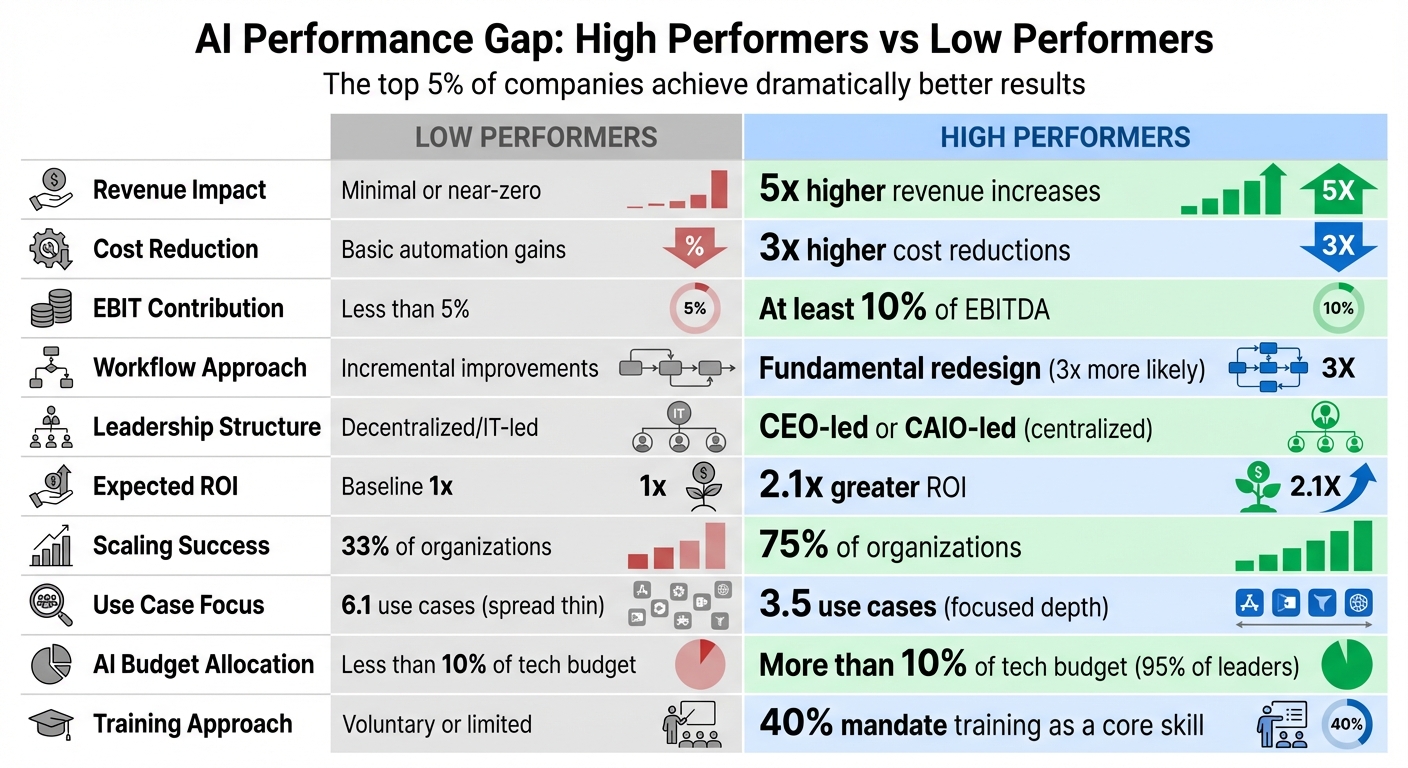
AI ROI Performance: High Performers vs Low Performers Comparison
Top-performing companies don't just tweak their processes - they rethink leadership, investment strategies, and their entire approach to change management. Unlike companies that lag behind, these leaders see AI as a game-changer for business transformation. The results? The top 5% of companies achieve five times higher revenue growth and three times greater cost reductions compared to their peers.
Performance Comparison: Low vs. High Performers
The gap between high and low performers becomes clear when you look at the numbers:
| Metric | Low Performers / Laggards | High Performers / Leaders |
|---|---|---|
| Revenue Impact | Minimal or near-zero | 5x higher revenue increases |
| Cost Reduction | Basic automation gains | 3x higher cost reductions |
| EBIT Contribution | Less than 5% | At least 10% of EBITDA |
| Workflow Approach | Incremental improvements | Fundamental redesign (3x more likely) |
| Leadership Structure | Decentralized/IT-led | CEO-led or CAIO-led (centralized) |
| Expected ROI | Baseline 1x | 2.1x greater ROI |
| Scaling Success | 33% of organizations | 75% of organizations |
| Use Case Focus | 6.1 use cases (spread thin) | 3.5 use cases (focused depth) |
| AI Budget Allocation | Less than 10% of tech budget | More than 10% of tech budget (95% of leaders) |
| Training Approach | Voluntary or limited | 40% mandate training as a core skill |
High-performing companies achieve more by focusing on fewer, high-impact use cases - averaging 3.5 compared to 6.1 for laggards. They also make strategic investments, with over 80% of their AI budgets directed at transforming key functions and developing new services.
Leadership is another critical factor. Companies with a Chief AI Officer (CAIO) see 10% higher ROI and are twice as successful at moving projects from pilot to production compared to those without. Furthermore, 95% of AI leaders allocate more than 10% of their tech budgets to AI initiatives.
These metrics underscore how leading organizations restructure their operations to fully integrate AI.
AI-First Companies: Outcomes and Strategies
AI-first companies go beyond incremental improvements; they rebuild their operations with AI at the core. The results are striking: they achieve 34 times more revenue per employee and develop products 16 times faster than traditional organizations.
Instead of asking, "How can AI improve what we already do?" they ask, "How should we reshape our work now that AI is here?" This shift in perspective drives sweeping changes - from how teams are organized to how success is measured.
These companies understand that AI alone doesn’t deliver value. They combine it with efforts to enhance data quality, reorganize teams, and streamline processes. The payoff? While most organizations take 2 to 4 years to see meaningful ROI from AI, 13% of high performers achieve it in under 12 months. Their secret lies in upfront investments in areas like workflow redesign, governance, and employee training, which allow them to unlock AI's potential much faster.
How HRbrain Fixes the ROI Problem
HRbrain has developed a practical approach to bridge the gap between AI investments and measurable results. Instead of lengthy reports or drawn-out consulting, they focus on short, actionable transformation sprints. These sprints are designed to deliver real outcomes - fully implemented workflows and decisions that businesses can act on - addressing the common integration and change management challenges that often derail AI projects.
Their approach is grounded in research showing that top-performing companies are 2.8 times more likely to redesign workflows from the ground up rather than simply adding AI to existing processes. HRbrain also incorporates the well-regarded 10-20-70 framework into their methodology, ensuring that every sprint is structured for maximum impact.
5-Day ROI Reset Sprint
The 5-Day ROI Reset Sprint (priced between $9,500 and $12,500) begins with a detailed review of your current AI efforts. The goal? Identify isolated use cases that provide limited benefits and fail to scale effectively. This step is critical because struggling companies tend to spread their efforts across an average of 6.1 use cases, while high performers focus on just 3.5.
By the end of the sprint, HRbrain delivers a clear set of Stop/Start/Scale decisions for each AI initiative:
- Stop: End projects that don’t align with measurable business goals.
- Start: Launch new workflows where AI has the potential to create meaningful impact.
- Scale: Expand successful initiatives that are already delivering results.
The sprint concludes with a 30-day action plan to implement one redesigned workflow. This plan includes designated owners, measurable KPIs, and accountability systems. With 95% of generative AI pilots failing due to poor integration and misaligned priorities, this sprint directly tackles the root causes of these failures.
3-Week Workflow Transformation Sprint
For businesses ready to go further, the 3-Week Workflow Transformation Sprint (priced between $18,000 and $28,000) takes a deeper dive by reimagining two core workflows. This sprint delivers everything needed for immediate execution: implementation steps, operating playbooks, governance controls, and adoption systems.
The process unfolds in three stages:
- Standalone AI agents handle specific tasks.
- Groups of agents take on end-to-end processes.
- Autonomous operations streamline entire business units.
To ensure success, HRbrain uses a “two-in-the-box” model, pairing business and tech teams to create workflows that are both technically sound and aligned with business objectives. Governance is built into the process through an AI Control Tower, which maintains a centralized inventory of AI assets, connects them to business services, and incorporates risk management from the start.
To encourage adoption, the sprint leverages a key insight: 45% of employees are more likely to use AI if it’s seamlessly integrated into their daily tasks. HRbrain establishes "middle-out" change management systems, where superusers mentor their peers. This approach helps embed AI into everyday workflows, turning it from a novelty into a natural part of how work gets done.
Conclusion: Converting AI Investments into Measurable Results
A staggering 95% of enterprise AI pilots fail to deliver measurable ROI, and the culprit isn’t the technology itself. Instead, it’s the lack of attention to change management that holds organizations back. When leaders view AI as just another tech project rather than a driver of business transformation, they risk seeing no returns on the $30 to $40 billion spent annually on enterprise AI.
Turning this around requires a shift in strategy. There are three key areas where organizations need to focus. First, rethink workflows from scratch instead of simply layering AI onto existing processes. High-performing companies are 2.8 times more likely to redesign workflows entirely. Second, build trust and governance frameworks to instill confidence in AI-driven decisions across teams. Finally, adopt tailored change strategies that align with your company’s structure - whether that’s top-down leadership in hierarchical setups or empowering key influencers in flatter organizations.
When companies embrace these changes, the results speak for themselves. Businesses with a Chief AI Officer see a 10% higher ROI, and those using centralized models can boost that figure by up to 36%. Moreover, involving at least 7% of employees in the transformation process doubles positive shareholder returns. As the BCG AI Radar Report highlights:
"Winning with AI is a sociological challenge as much as a technological one. The soft stuff - reimagining workflows, upskilling talent, and driving organizational change - turns out to be the hard stuff."
For mid-market leaders, HRbrain bridges this gap by delivering fast, measurable outcomes. With focused sprints that include Stop/Start/Scale decisions, redesigned workflows, and clear ownership tied to KPIs, HRbrain ensures AI investments translate into real business results. Tackling the fundamentals of change management is the key to closing the ROI gap.
FAQs
Why don’t most companies see a return on their AI investments?
Many businesses fail to achieve a return on investment (ROI) from AI because they treat it as just another tech project rather than a broader business transformation. In fact, research indicates that 95% of generative AI pilots don’t yield measurable profits - primarily because companies often overlook the critical need for change management. Without rethinking workflows, governance, and accountability, AI initiatives rarely reach their full potential.
A common pitfall is underestimating the importance of clear leadership, well-defined KPIs, and alignment with the company’s culture. This lack of preparation often results in disjointed efforts and missed chances to integrate AI into essential business operations. To truly benefit from AI investments, companies need to focus on transforming their processes and systems, not just adopting new technology.
Why is workflow redesign critical for achieving AI ROI?
Redesigning workflows is crucial for converting AI investments into tangible business outcomes. Research highlights that companies seeing real success with AI aren't just automating tasks - they're rethinking entire business units. By revamping processes, businesses can establish clear handoffs, embed AI insights into decision-making, and assign responsibility for results. This approach minimizes friction, ensures AI outputs are actionable, and makes it easier to track key performance indicators (KPIs).
Achieving success with AI also requires a clear vision that reshapes team dynamics and encourages employees to collaborate on AI-driven solutions. Thoughtfully reengineered workflows integrate governance, data pipelines, and accountability from the outset, transforming experimental AI applications into scalable, revenue-producing systems. Companies that pair workflow redesign with focused sprints to prioritize initiatives can close the gap between AI investments and measurable returns.
How does a Chief AI Officer (CAIO) help improve the ROI of AI investments?
A Chief AI Officer (CAIO) is pivotal in converting AI investments into tangible business results. Positioned within the C-suite, the CAIO ensures that AI projects are tightly aligned with the company’s overarching strategy and financial objectives. They oversee governance, establish clear KPIs, and ensure accountability, turning fragmented AI experiments into scalable, revenue-driving solutions.
Studies reveal that organizations with a CAIO experience up to a 10% boost in AI ROI, which can climb to 36% when the CAIO operates under a centralized framework. By championing change management, rethinking workflows, and fostering shared accountability across departments, the CAIO bridges the leadership gap often linked to underwhelming AI returns. Their emphasis on measurable outcomes guarantees that every AI initiative contributes real, quantifiable value.