Most businesses fail to see returns on AI investments - and outdated metrics are a big reason why. Companies have spent billions on AI, yet 95% report no measurable ROI from generative AI. Why? They're using old metrics like hours worked or logins, which miss the value AI adds to knowledge work.
Here’s the issue: Traditional metrics focus on inputs (e.g., tasks completed), while AI-driven metrics prioritize outcomes (e.g., faster processes, better quality). For example, Maersk improved supply chain efficiency by shifting KPIs from speed to reliability. Similarly, Hitachi tracked employee happiness using AI, leading to higher profits and productivity.
Key takeaways:
- Old metrics: Easy to track but miss complex impacts.
- AI metrics: Predict outcomes, suggest actions, and integrate data across teams.
- Challenges: High costs, risks like algorithm bias, and the need for better training.
Companies that redesign workflows and use AI-driven KPIs are 3x more likely to see financial gains. Tools like HRbrain help bridge the gap by auditing AI use, refining KPIs, and ensuring measurable results. The real challenge isn’t AI itself - it’s how we measure its value.
The 3 AI Business Outcomes That Matter: ROI, ROE, ROF
sbb-itb-34a8e9f
1. Traditional Metrics
For decades, organizations have leaned heavily on activity-based metrics to evaluate employee performance and workplace harmony. These measures - like hours worked, time spent on tasks, units produced, or revenue per employee - focus on inputs rather than the actual value delivered. While easy to track with existing systems, they primarily reflect the organization's perspective, often overlooking the deeper contributions of individual workers. In today's knowledge-driven workplaces, these metrics are becoming increasingly outdated.
Despite this, 74% of leaders acknowledge the need for better performance metrics, while only 17% of organizations succeed in measuring true worker value. Traditional methods also carry a heavy bias. Take annual performance reviews, for example - they're often skewed by recency bias, where managers disproportionately weigh recent activities over the full scope of an employee's year-long performance. Other biases, like favoritism and subjectivity, further distort evaluations, making it harder to recognize and reward genuine talent.
A great example of the pitfalls of traditional metrics comes from Wayfair. The online retailer realized their "lost-sales" KPI was misleading. According to CTO Fiona Tan, in 50% to 60% of cases, a "lost" sale on a specific item actually resulted in the customer purchasing another product in the same category. By shifting from item-based metrics to category-focused retention metrics, Wayfair improved both product recommendations and logistics. This illustrates how traditional metrics can lead to flawed decision-making when they fail to capture the full picture.
Another case is Maersk, the global shipping giant. For years, they measured productivity by how quickly ships were loaded and unloaded. However, AI analysis revealed that prioritizing speed often caused bottlenecks elsewhere in the supply chain. By redefining their KPI to focus on "reliable departures" instead of pure speed, Maersk enhanced overall network efficiency and customer satisfaction. This shift underscores how traditional metrics can sometimes optimize individual performance at the expense of broader business goals.
There's also the challenge of updating these entrenched systems. 60% of managers believe their current KPIs require serious improvement to support effective decision-making. Many traditional metrics remain deeply embedded in legacy systems, making them feel outdated and disconnected. They fail to capture the problem-solving, creativity, and collaboration that are key to modern knowledge work. These gaps highlight the need for AI-driven metrics, which emphasize value creation over mere activity tracking.
2. AI-Driven Metrics
AI metrics are reshaping how performance is assessed, shifting the focus from simply tracking activities to predicting outcomes and suggesting actionable steps. These metrics fall into three categories: descriptive, predictive, and prescriptive. This evolution is more than just a technical upgrade - it’s about creating measurable improvements, as demonstrated by practical applications in various industries.
Traditional activity-based measures often fall short when it comes to driving meaningful outcomes. AI metrics, however, bring a results-oriented approach. Take Hitachi, for instance. By using AI and wearable devices to monitor worker happiness instead of just tracking hours worked, they saw impressive results: a 33% boost in psychological capital, a 10% rise in profits, and a 34% increase in sales per hour at call centers between 2020 and 2021. Similarly, MetLife leveraged AI coaching to help agents have more meaningful, human conversations with customers, leading to a 13% increase in customer satisfaction. These examples highlight how focusing on outcomes rather than activities can deliver real business value.
Another advantage of AI metrics is their ability to overcome the limitations of traditional reviews, which often suffer from recency bias. AI gathers continuous, long-term data from passive sources like emails, calendars, and collaboration tools, eliminating the need for manual reporting and reducing subjective judgments. This continuous data collection allows organizations to make decisions based on a broader and more objective dataset. Companies using AI-enabled KPIs are five times more likely to align their incentive structures with their objectives compared to those relying on outdated metrics. Furthermore, 90% of managers who use AI to develop new KPIs report that their metrics have improved.
AI also excels at integrating data across different functions. For example, Sanofi introduced the "Plai" app to around 10,000 executives, combining internal data with predictive analytics. The app provides recommendations for adjusting sales activities based on supply chain performance, creating a unified view across sales and finance. At Pernod Ricard, AI bridged two previously disconnected KPIs - profit margins and market share - enabling leaders to optimize both simultaneously, a feat that was nearly impossible with traditional systems. This level of cross-functional insight is a game-changer for decision-making.
Reimagining KPIs with AI can deliver up to three times the financial benefits, but it requires a thoughtful redesign of metrics governance. This includes co-creating KPIs with stakeholders and establishing clear accountability. As Michael Schrage from MIT Sloan aptly puts it:
Accountability for performance on KPIs is increasingly insufficient; companies need accountability for the performance of KPIs, too.
To truly harness the potential of AI metrics, organizations must rethink how they design and govern their KPIs. This transformation lays the groundwork for achieving measurable and lasting improvements, paving the way for deeper analysis and innovation.
Pros and Cons
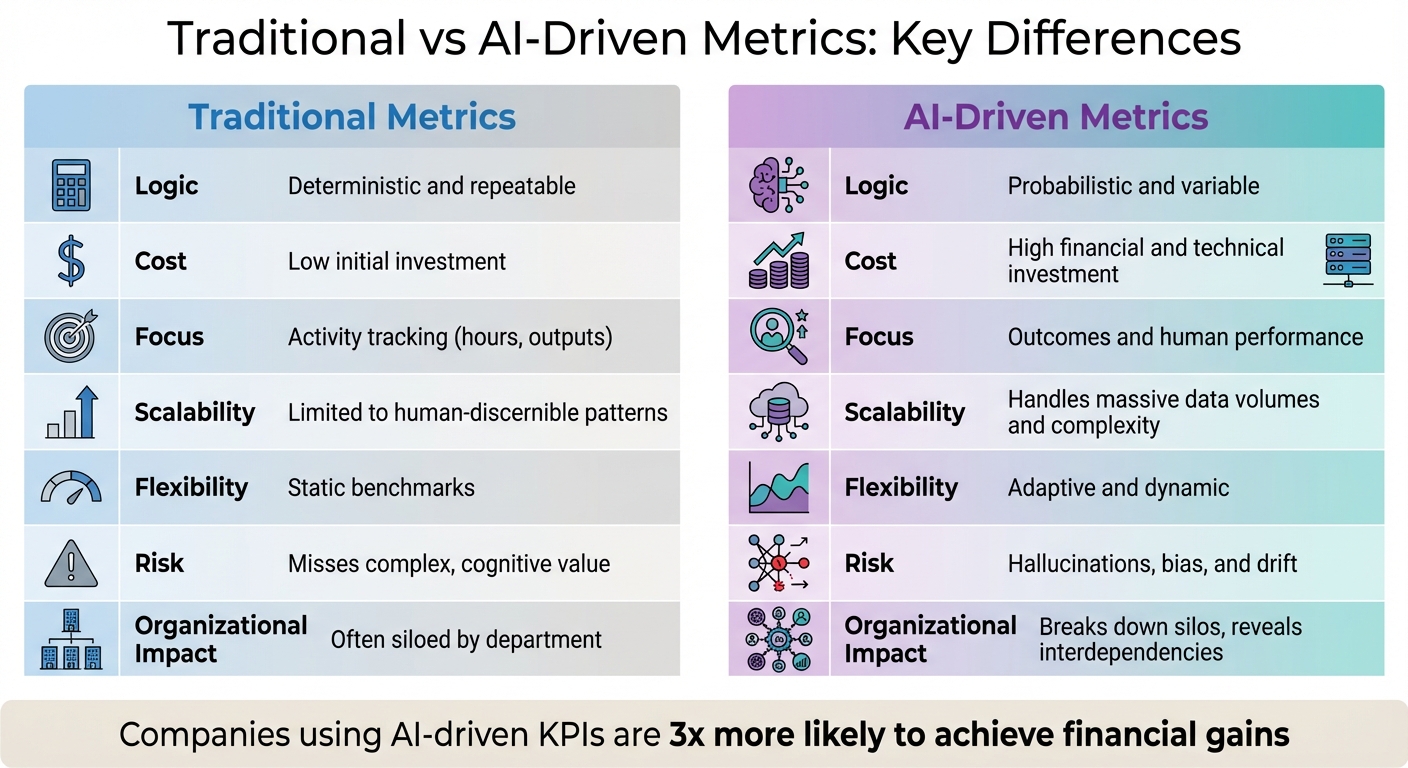
Traditional vs AI-Driven Metrics Comparison Chart
Traditional metrics operate on a deterministic model - specific inputs always lead to fixed outputs. On the other hand, AI metrics are probabilistic, meaning the same input can yield different outcomes depending on various factors. This fundamental difference influences everything from cost considerations to accuracy. Let’s dive into how these two approaches compare.
Traditional metrics rely heavily on human judgment, which keeps initial costs low and makes implementation straightforward. However, they often fall short in capturing the bigger picture. These metrics tend to focus on isolated data points, ignoring critical context like historical relationships or external influences. Scalability is another challenge - managing thousands of interconnected variables manually is virtually impossible. This limitation highlights the growing need for a more modern approach to metrics.
AI-driven metrics, on the other hand, excel in scalability and uncovering complex patterns that might elude human analysis. They transition from static measurements to dynamic predictors, offering the ability to anticipate changes in market conditions. However, this power comes at a cost. Implementing AI metrics requires a substantial financial investment, cutting-edge algorithms, and collaboration across multiple teams, including product, engineering, risk, legal, and operations. Adding to the challenge, 62% of C-suite executives report a lack of AI expertise as a significant hurdle.
While traditional metrics are cost-effective, they lack the sophistication to account for the complexities of modern cognitive work. Conversely, AI metrics can "drift" over time as data or environments evolve, and they carry risks like algorithmic bias or hallucinations if not carefully monitored. Trust is another sticking point: although 93% of leaders claim to use data responsibly, only 70% of employees feel the same level of confidence.
Here’s a quick comparison of the key differences between traditional and AI-driven metrics:
| Feature | Traditional Metrics | AI-Driven Metrics |
|---|---|---|
| Logic | Deterministic and repeatable | Probabilistic and variable |
| Cost | Low initial investment | High financial and technical investment |
| Focus | Activity tracking (hours, outputs) | Outcomes and human performance |
| Scalability | Limited to human-discernible patterns | Handles massive data volumes and complexity |
| Flexibility | Static benchmarks | Adaptive and dynamic |
| Risk | Misses complex, cognitive value | Hallucinations, bias, and drift |
| Organizational Impact | Often siloed by department | Breaks down silos, reveals interdependencies |
Conclusion
Choosing between traditional metrics and AI-driven metrics goes beyond just technology - it's about turning insights into meaningful action. Traditional metrics are great for monitoring straightforward, repetitive processes with minimal initial costs. However, they often fail to capture the intricate patterns that influence modern business success. On the other hand, AI-driven metrics demand a higher investment but offer something entirely different: the ability to predict outcomes, provide actionable recommendations, and optimize multiple variables at once.
Organizations that integrate AI into their KPIs are three times more likely to achieve financial gains and five times more likely to align incentives with their business goals. The real challenge isn’t a lack of awareness - it’s in executing these strategies effectively.
This is where implementation becomes critical. Many companies struggle to see real value from AI because they focus too much on deploying the technology itself, rather than redesigning workflows and accountability systems to translate AI investments into measurable results. The businesses achieving a 74% success rate in advanced AI initiatives aren’t just using better algorithms - they’re rethinking how work is done from the ground up. This highlights the importance of having a clear, focused strategy for execution.
HRbrain addresses this challenge with its targeted sprint framework, designed to turn insights into actionable changes. Recognizing that technology alone can’t close the implementation gap, HRbrain uses a sprint-based approach to rework workflows and accountability systems, ensuring AI investments lead to tangible outcomes. Their sprints focus on auditing AI initiatives, providing clear Stop/Start/Scale decisions, and redesigning workflows with measurable KPIs. These sprints follow an iterative cycle - Discovery, Build, Launch, and Run - allowing teams to define Minimum Viable Quality upfront and monitor progress over time.
The biggest obstacle to unlocking AI’s ROI potential isn’t technological - it’s organizational. Shifting the focus from simply tracking activities to measuring outcomes transforms AI from being just another costly experiment into a powerful tool for driving real, measurable results.
FAQs
How are AI-driven metrics different from traditional performance metrics?
AI-driven metrics stand apart from traditional performance metrics by being more flexible, forward-thinking, and outcome-oriented. Traditional metrics tend to focus on static measures like revenue or productivity. In contrast, AI metrics are built to adapt to evolving conditions and provide insights that can lead to actionable decisions. They prioritize factors like the quality, scalability, and overall impact of AI systems, rather than just monitoring basic usage or output.
These metrics are also closely tied to broader strategic objectives. For instance, they help assess how AI contributes to better decision-making, enhanced customer experiences, or greater operational efficiency. By utilizing real-time data and predictive analytics, AI metrics empower organizations to make continuous adjustments, ensuring they can effectively measure the value AI adds to their processes. This approach captures the increasingly complex and evolving role of AI in driving meaningful performance gains.
What challenges might organizations face when implementing AI-driven metrics?
Organizations often face several obstacles when trying to implement AI-driven metrics effectively. One major challenge lies in defining key performance indicators (KPIs) that genuinely capture how AI impacts business outcomes. Without clear benchmarks or standards, measurement practices can become inconsistent, making it tough to evaluate the real value of AI initiatives.
Another frequent issue is the disconnect between AI metrics and actual business results. Many companies zero in on activity-based metrics - like the number of models deployed - rather than focusing on outcomes that demonstrate measurable ROI. On top of that, resistance to new measurement frameworks can slow progress. Whether it’s due to ingrained habits, skepticism about AI’s practicality, or viewing it as experimental, this resistance can prevent AI metrics from becoming a natural part of day-to-day operations.
Lastly, a lack of proper governance, expertise, or infrastructure often hinders the ability to track, interpret, and act on AI metrics. Without these foundational elements, organizations may struggle to unlock the full potential of AI to drive meaningful improvements.
How can businesses achieve measurable ROI from their AI investments?
To see real returns on AI investments, businesses need to tie their AI projects to specific, actionable goals - whether that's cutting costs, improving decision-making, or boosting customer retention. Having clear objectives ensures that AI initiatives focus on what truly matters.
A well-defined measurement framework is also critical. This means tracking key performance indicators (KPIs) like productivity improvements, revenue increases, or streamlined processes. Regularly monitoring these metrics keeps everyone accountable and ensures visibility into progress. It’s also worth looking at non-financial metrics, such as how AI impacts employee engagement or supports broader strategic goals.
By keeping a close eye on outcomes and making adjustments along the way, companies can turn AI investments into measurable results, bridging the ROI gap and creating lasting value.