AI investments often fail to deliver measurable returns for mid-sized businesses. While companies spend billions on AI, most struggle to scale projects effectively due to workflow bottlenecks. These bottlenecks - caused by resource gaps, poor data, slow decision-making, or low adoption - block progress and prevent AI from driving real value.
Key insights:
- 95% of businesses see no ROI from generative AI, despite billions spent.
- Bottlenecks often stem from talent shortages (62%), poor data quality, and manual workarounds.
- AI can identify and address constraints through tools like process mining and predictive analytics.
- Success depends on workflow redesign, governance, and clear metrics like cost per transaction or cycle time reduction.
To succeed, leaders must:
- Start projects with clear ROI potential.
- Stop or pivot initiatives that fail to deliver results.
- Scale pilots with proven impact.
AI-driven bottleneck detection helps businesses pinpoint constraints, streamline workflows, and turn stalled projects into profitable ventures.
What Is Process Mining? AI to Find Bottlenecks Fast ⚙️🤖
What Are Bottlenecks in AI-Enabled Workflows
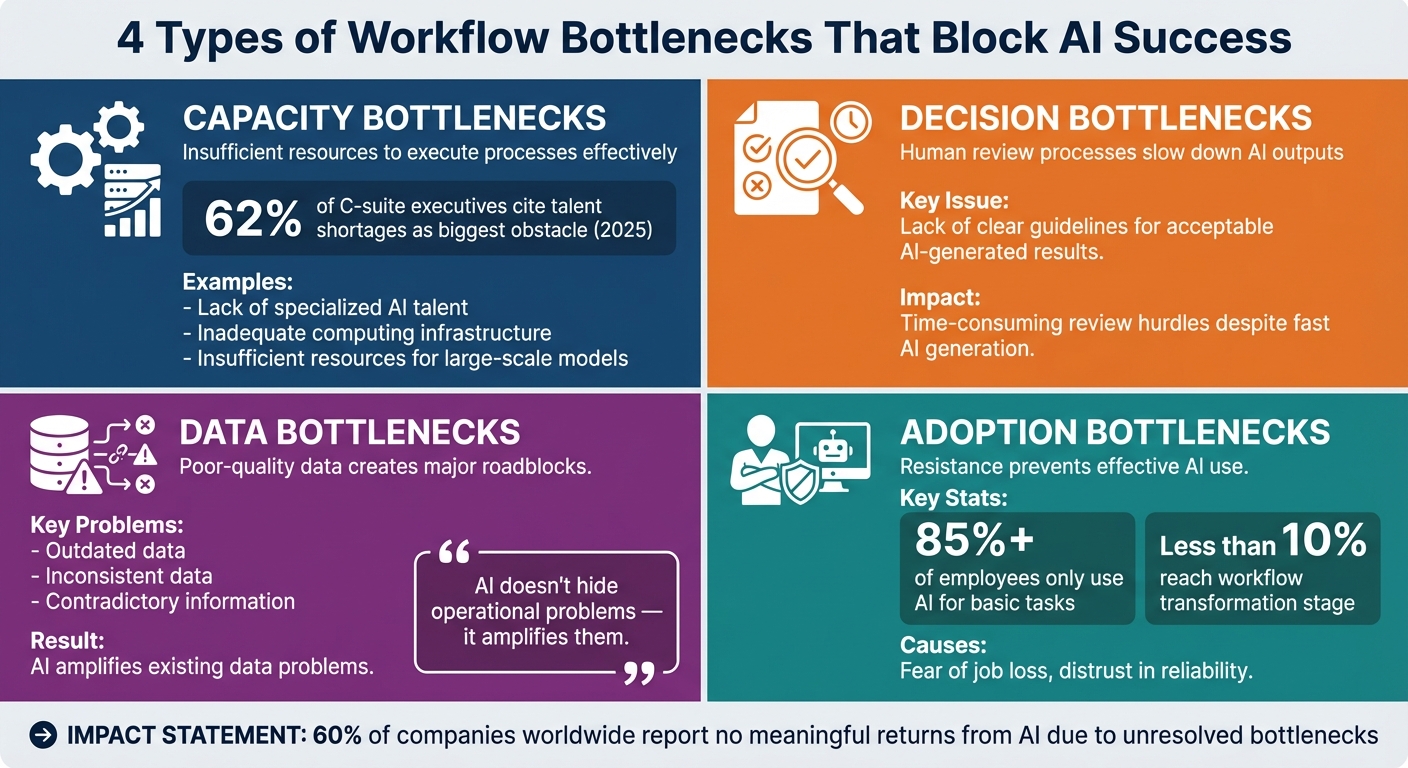
4 Types of AI Workflow Bottlenecks and Their Solutions
A bottleneck happens when progress slows or stalls because of missing resources - like skilled talent or computing power - or incomplete outputs. In AI-enabled workflows, these issues don’t magically vanish with new technology. In fact, AI often highlights bottlenecks that were previously masked by manual workarounds.
The main challenge is something experts refer to as the "micro-productivity trap". Companies focus on optimizing small tasks - like drafting an email faster or generating reports instantly - but fail to improve the entire workflow. For example, an AI tool may accurately predict customer demand, but if your warehouse operations are inefficient, that insight won’t lead to increased revenue. Instead, AI ends up amplifying inefficiencies further down the line.
"AI doesn't hide operational problems - it amplifies them. If data and inputs are messy, the AI outputs expose the inconsistency of underlying systems and processes."
– Ashish Patel, Founder, Simpat Tech
This explains why 60% of companies worldwide report no meaningful returns from AI, even after significant investments. They may improve one part of the process, but bottlenecks in subsequent steps prevent real progress.
4 Types of Workflow Bottlenecks
Different types of bottlenecks require specific solutions to address their root causes.
1. Capacity Bottlenecks
These arise when there aren’t enough resources to execute a process effectively. For many mid-sized companies, this could mean a lack of specialized AI talent or inadequate computing infrastructure to handle large-scale models. In 2025, 62% of C-suite executives identified talent shortages as their biggest obstacle to fully leveraging AI. Without the right people and tools, scaling AI becomes impossible.
2. Decision Bottlenecks
Even though AI can generate outputs quickly, human review often slows things down. Without clear guidelines on what constitutes an acceptable AI-generated result, the review process can become a time-consuming hurdle.
3. Data Bottlenecks
Poor-quality data creates major roadblocks. When data is outdated, inconsistent, or contradictory, AI outputs are compromised right from the start. For instance, a sales forecasting tool won’t work effectively if the CRM data it relies on is inaccurate or if different teams define "qualified lead" inconsistently. In such cases, AI merely amplifies existing data problems.
4. Adoption Bottlenecks
Resistance to AI - whether due to fears of job loss or distrust in its reliability - can prevent its effective use. Employees often underutilize AI tools, keeping organizations stuck in early adoption phases. In fact, more than 85% of employees only use AI for basic task assistance, while fewer than 10% reach the stage where AI fundamentally reshapes their workflows.
If left unaddressed, these bottlenecks can significantly delay AI transformation efforts.
Why AI Initiatives Stall at Bottlenecks
When companies implement AI without rethinking their workflows, bottlenecks are bound to emerge. Simply adding AI to existing processes often results in localized efficiency gains that don’t scale.
Take the example of an international airline in 2023. The airline used AI to optimize cargo space and pricing. While the AI accurately predicted available capacity, many planes still flew under capacity. Why? A secondary bottleneck appeared: ground crews weren’t packing cargo efficiently due to outdated palletizing procedures. The airline had to retrain its staff before the AI could deliver its intended benefits.
"Technology usually unveils a bottleneck in the process that needs to be solved to realize the technology's value."
– Eric Lamarre, Senior Partner, McKinsey
This pattern is common: AI speeds up one part of the process but then reveals the next constraint. If that constraint isn’t resolved, progress stalls. Metrics like cycle time and error rates often highlight these bottlenecks. If those metrics don’t improve after adopting AI, it’s a clear sign of unresolved issues further down the chain.
Currently, only 13% of organizations have successfully integrated AI broadly across their workflows. Most are still focused on optimizing isolated tasks instead of redesigning their entire processes.
How AI Detects Workflow Bottlenecks
AI doesn't just make processes faster - it digs deep to uncover where work gets stuck. It works through four key stages: Identify (using historical data to spot current constraints), Diagnose (pinpointing root causes like maintenance delays or inefficient cycle times), Predict (anticipating future bottlenecks), and Prescribe (suggesting targeted solutions). This systematic approach turns workflow uncertainties into actionable insights, bridging the gap between AI investments and measurable outcomes. By addressing bottlenecks, organizations can make smarter decisions about what to start, stop, or scale next.
AI Techniques for Bottleneck Detection
Process mining is a standout tool in this area. It creates a "digital twin" of your workflows by analyzing logs from systems like ERP and CRM software. This digital model provides a clear picture of how work currently flows through your organization. In fact, in 2025, 72% of C-suite executives reported that AI-powered process mining improved both efficiency and cost management.
Predictive analytics takes things a step further by forecasting where task bottlenecks might arise. Advanced methods like Long Short-Term Memory (LSTM) networks and Gated Recurrent Units (GRUs) are particularly effective in identifying shifting constraints in dynamic production lines. These tools can adapt to variables like product mix changes or operator delays. Meanwhile, anomaly detection flags unusual patterns in shop floor data, signaling potential process delays.
These techniques address a common challenge in mid-sized businesses: equivocality - the confusion that arises when teams disagree about the causes of delays. AI eliminates guesswork by providing objective, data-backed conclusions based on throughput metrics, rather than subjective viewpoints.
Data Requirements for Effective Detection
For AI to effectively detect bottlenecks, it needs accurate and reliable data. This includes system logs, workload capacity metrics, and quality indicators. Verifying data accuracy is critical, and audits play a key role by using tools like lineage tracking and NLP to analyze unstructured sources. In manufacturing, essential data points include unplanned downtime, variable processing times, setup durations, and operator delays.
The real hurdle isn’t gathering data - it’s ensuring its consistency and accuracy. AI-driven audits help by identifying gaps or inconsistencies in datasets. Data lineage tracking provides a clear path from the source to every transformation, ensuring leaders can trust the insights they’re acting on.
"The familiar idea of 'garbage in, garbage out' turns into wrong predictions, unfair decisions, and broken trust."
– iAvva AI
Converting Insights into Actionable Outputs
AI doesn’t stop at detection - it transforms insights into prioritized actions. Tools like visual heatmaps and ranked constraints help managers zero in on the most pressing bottlenecks, while simulations predict the impact of potential changes. Digital twins add another layer by allowing teams to test "what-if" scenarios before making decisions.
AI also identifies opportunities for Robotic Process Automation (RPA) by spotting repetitive, high-volume tasks that slow things down. It distinguishes between task bottlenecks (caused by complexity or centralization) and resource bottlenecks (caused by equipment or labor shortages). This clarity helps organizations decide whether to invest in new resources or redesign workflows, paving the way for operational improvements.
Studies show that real-world production systems often experience throughput losses of 20% to 30%. Companies that adopt AI-powered process mining report an average of 8% annual growth. However, these benefits only come to life when AI insights are translated into concrete actions - leaving them as abstract dashboard metrics won’t cut it.
sbb-itb-34a8e9f
Making Start, Stop, Scale Decisions Using AI Insights
Spotting bottlenecks is just the beginning - what truly matters is turning those insights into actionable steps. For AI investments to deliver real results, leaders need to take decisive action: figure out which projects to back, which to halt or adjust, and which are ready to expand.
Decision Criteria for Start, Stop, Scale
Projects should only start when there's a clear path to delivering value, whether through growth, cost savings, or productivity improvements. For example, DBS Bank set an ambitious goal of running 1,000 experiments annually starting in 2022. This effort is expected to boost its AI-driven economic impact from S$150 million to S$370 million by 2024.
Stop or Pivot initiatives when performance metrics fail to deliver. Research shows 85% of employees spend time on low-value tasks like drafting emails. If a project remains stuck in "information assistance" mode without progressing to "semiautonomous collaboration", it's unlikely to deliver meaningful results. Guardian Life Insurance, for instance, piloted an AI-driven RFP system that cut proposal generation time from 5–7 days to just 24 hours. They closely monitored this success before deciding to scale the initiative in 2026.
Scale efforts when the necessary infrastructure is in place and staff are ready to embrace the changes. Ally Bank is a great example. In July 2023, it launched the Ally.ai platform, which saved three minutes per customer call across more than four million calls and sped up marketing campaign development by 34%.
| Decision Type | Primary Criteria | Key Bottleneck Indicator |
|---|---|---|
| Start | Alignment with growth goals; P&L impact | Lack of a clear business case or accessible data |
| Stop / Pivot | Poor metrics; no value indicators | High error rates; low trust; tedious reviews |
| Scale | Reusable systems; workforce readiness | Unauthorized AI use; lack of support; skill gaps |
Quantitative Decision Framework
To remove guesswork, a scoring model can prioritize initiatives. Research from MIT highlights that companies in the "Experiment" phase (Stage 1) grow 26.5 percentage points below their industry average, while those in the "Future Ready" phase (Stage 4) achieve growth 13.9 percentage points above average.
The 4S Framework can guide decisions: Strategy (aligning with business goals), Systems (building reusable infrastructure), Synchronization (ensuring employees are well-prepared), and Stewardship (maintaining governance and compliance). For instance, Italgas Group used 18 cross-functional teams working in four-month sprints to deploy AI solutions. One project sped up completion times by 40% and cut inspection times by 80%.
While AI projects often take longer to deliver returns compared to other technologies - typically 2 to 4 years versus 7 to 12 months - only 6% of organizations report AI payback in under a year. Decision-making frameworks must consider these timelines. Generative AI projects, aimed at quick efficiency gains, might see returns in under a year. Meanwhile, Agentic AI initiatives, which require a full process overhaul, can take 3 to 5 years.
To succeed, a strong quantitative framework must be paired with rigorous governance to ensure accountability and long-term success.
Governance and Accountability
Clear leadership and well-defined KPIs are non-negotiable. Boards need to move beyond passive observation and take an active role in driving AI performance, linking it directly to P&L outcomes. According to BCG, the "10-20-70 Rule" is key: dedicate 10% of efforts to algorithms, 20% to technology and data, and 70% to people and process changes.
A transparent dashboard can track progress on metrics like cycle-time reductions, productivity improvements, and cost savings. For example, in September 2024, Italgas Group redefined its Chief Human Resources Officer role to Chief People, Innovation, and Transformation Officer (CPITO). They also created a Group AI Office and appointed an AI Director reporting to both the CPITO and CIO.
"Board oversight of an AI transformation must be continuous, rigorous, and substantive. Too often, governance discussions become buried in status decks." – BCG
Guardian Life Insurance streamlined governance by introducing a fast-track review board with experts in technical risk, data privacy, and cybersecurity to speed up project approvals. Kaiser Permanente, on the other hand, developed seven guiding principles - privacy, reliability, quality outcomes, transparency, equity, customer focus, and trust - to ensure AI is used responsibly.
Tying management incentives to realized AI value can also drive success. With only 36% of employees feeling adequately trained in AI, scaling efforts can face significant roadblocks. To address this, organizations should mandate AI fluency (a practice embraced by 40% of top-performing AI companies) and encourage peer-to-peer learning, which 69% of employees find highly effective for building skills.
Implementing AI-Driven Bottleneck Detection
Incorporating AI-driven bottleneck detection into daily operations turns one-off successes into ongoing improvements. For mid-market leaders, it’s time to move beyond occasional reviews and weave AI-driven monitoring into the everyday workflow.
Continuous Monitoring for Better Outcomes
Real-time monitoring beats periodic reviews by a mile. Instead of waiting for monthly check-ins, AI-enabled dashboards can monitor workflows around the clock, flagging issues the moment they arise. This proactive approach helps nip small problems in the bud before they snowball into major disruptions.
With a unified dashboard, managers can track both operational metrics and business outcomes seamlessly. Automated alerts, for instance, can notify teams when performance metrics - like model accuracy or data quality - take a dip, enabling quick corrective action. A prime example is DBS Bank, which set an ambitious goal of running 1,000 AI experiments annually starting in 2022. By combining continuous monitoring with operational data and natural language processing, the bank boosted its AI-driven economic impact from S$150 million in 2022 to S$370 million by 2024.
Change Management: The Human Factor in AI Adoption
AI alone won’t solve bottlenecks - organizational change is just as important. Research highlights the 10-20-70 rule, emphasizing that a majority of AI implementation efforts should focus on people and processes. To make AI adoption a success, organizations need to prioritize AI fluency at all levels. Training should be ongoing, with regular reinforcement and weekly tracking to celebrate early wins and tackle roadblocks.
Aligning incentives with new behaviors is equally critical. Peer-to-peer learning can speed up adoption as employees share best practices and lessons learned in collaborative settings. By securing organizational buy-in through effective change management, teams can focus on proving ROI, ensuring that AI investments translate into measurable business outcomes.
Showing ROI Through Clear Metrics
CFOs want numbers, not narratives. To prove the value of AI-driven bottleneck detection, start by establishing an 8- to 12-week baseline for key metrics like cycle time, transaction cost, and revenue per employee. Then track improvements against these indicators:
- Cycle time reduction: How much faster are workflows moving?
- Cost per transaction: Are you handling more without increasing headcount?
- Revenue per employee: Has efficiency translated into higher output per individual?
A great example comes from IT management platform Atera, which partnered with Microsoft Azure OpenAI in 2025. By using AI-generated diagnostics, technicians increased their capacity from handling seven cases per day to an impressive 70 - a tenfold productivity boost. However, these gains only matter if the saved time is redirected to higher-value activities. For instance, if proposal preparation time drops from five days to one, the extra time should be used to drive revenue or improve operations.
"CFOs don't fund projects based on vibes. They fund projects based on measurable dollar savings." – Keith Townsend, Founder, The CTO Advisor
To make a compelling case, frame ROI in executive-friendly terms like Net Present Value (NPV), Payback Period, and Internal Rate of Return (IRR). While AI initiatives often take 2 to 4 years to deliver strong ROI - longer than the 7 to 12 months typical for traditional IT investments - setting realistic expectations and tracking progress weekly can help teams adapt if adoption slows.
| Metric Category | Example KPI | Business Impact |
|---|---|---|
| Efficiency | Task automation rate (%) | Free up labor for higher-value work |
| Operational | Error reduction rate (%) | Fewer reworks, better quality |
| Financial | Cost per transaction | Lower operational expenses |
| Strategic | User adoption/trust levels | Deeper integration into daily workflows |
HRbrain offers a streamlined approach with its 5-day ROI Reset Sprint, which evaluates all AI initiatives, delivering actionable Stop/Start/Scale decisions and a 30-day plan to implement workflows with clear ownership and KPIs. Their 3-week Workflow Transformation Sprint redesigns two workflows from start to finish, complete with implementation guides, operating playbooks, and adoption frameworks. Both sprints focus on turning AI investments into measurable results.
Conclusion
AI-powered bottleneck detection gives mid-market leaders the tools to make informed decisions about when to start, stop, or scale initiatives. By tapping into real-time data, these leaders can identify where AI is driving measurable value. Companies that successfully scale AI across their core workflows achieve EBITDA gains of 10% to 25%. On the other hand, failing to redesign workflows effectively leads to only minor improvements.
The real challenge lies beyond identifying bottlenecks - it’s about taking bold and decisive action. Two key factors determine success: workflow redesign and governance. Rethinking workflows, investing in skill development, and embracing change can lead to 2.1 times higher returns on AI investments. Companies that treat AI as just another tech upgrade often see no measurable benefits. But those that fundamentally change how work is done - using the 10-20-70 rule (10% algorithms, 20% data and tech, 70% people and processes) - unlock significant financial gains.
For example, Guardian Life Insurance used AI to overhaul its RFP process. The time required to generate proposals dropped from five-to-seven days to just 24 hours, with plans to scale the initiative further by 2026.
Governance plays an equally critical role. With 67% of organizations lacking formal AI governance structures, leading companies are setting the standard by building early frameworks. These frameworks address risks, legal considerations, and data privacy, prioritizing depth over breadth. Such governance ensures that AI initiatives are both scalable and sustainable, reinforcing earlier insights into actionable AI transformations.
Building on the earlier discussion of AI’s role in identifying process bottlenecks, the next steps are clear: use AI to spot inefficiencies, redesign workflows, establish strong governance, and monitor key metrics like cycle time and cost per transaction. This structured approach doesn’t just improve processes - it drives measurable financial outcomes.
FAQs
How does AI help mid-sized businesses identify and fix workflow bottlenecks?
AI takes the guesswork out of identifying and fixing workflow bottlenecks by leveraging data-driven insights. By analyzing event logs from systems like ERP, CRM, and collaboration tools, it maps out processes and pinpoints delays - whether they stem from resource shortages or dependencies further up the chain. Using machine learning, these bottlenecks are then ranked based on how much they affect efficiency and costs, providing decision-makers with a clear plan of action.
After identifying the issues, AI doesn't stop there. It can recommend optimized workflows, reassign resources, or even suggest automation to remove obstacles. This involves steps like mapping workflows, evaluating bottlenecks, running simulations to predict ROI, and implementing redesigned processes with defined KPIs and accountability measures. For mid-sized businesses, this method ensures that AI investments lead to tangible improvements in performance and drive growth.
What challenges do companies face when trying to scale AI initiatives?
Scaling AI isn’t just about pouring resources into better models or more computing power. The real challenge lies in tackling the barriers that keep projects stuck in the pilot phase. One major issue? Many companies treat AI as an isolated tool rather than weaving it into the fabric of their core operations. As a result, nearly two-thirds of organizations are still experimenting and haven’t managed to scale AI across their entire business.
Technical hurdles add another layer of complexity. As AI models become more advanced, performance gaps grow, and outdated or incompatible infrastructure slows progress to a crawl. But scaling AI isn’t just a technical problem - it requires a coordinated effort across strategy, talent, data management, and governance. Unfortunately, many companies lack the leadership or clear metrics to guide this transformation effectively.
That’s where HRbrain steps in. Designed for mid-market leaders, HRbrain identifies critical bottlenecks, reimagines workflows, and provides actionable "Stop/Start/Scale" recommendations. By focusing on measurable results, HRbrain helps businesses move beyond isolated pilot projects and achieve organization-wide AI integration.
Why is governance essential for successful AI implementation, and how can organizations improve it?
Governance plays a key role in the success of AI, ensuring that the data driving these models is trustworthy, models adhere to legal and ethical norms, and risks like bias or privacy concerns are properly handled. Without strong governance, organizations often hit roadblocks when trying to scale AI projects and risk losing the confidence of both customers and regulators.
To strengthen AI governance, companies should embed governance practices throughout the entire AI lifecycle. This involves steps like evaluating data sources to understand their sensitivity, assigning clear ownership roles, automating data quality checks, and keeping a close eye on models to address issues like bias or performance drift. Creating cross-functional teams to maintain accountability and align AI outcomes with business objectives can also lead to better results. HRbrain supports organizations in tackling these challenges by rethinking workflows, governance frameworks, and accountability systems, helping to maximize returns on AI investments.
