Most companies are investing heavily in AI but aren't seeing meaningful returns. Why? The issue lies in the difference between AI adoption and AI transformation:
- AI adoption: Adding AI tools to existing workflows for small productivity boosts.
- AI transformation: Redesigning processes entirely around AI for deeper, long-term impact.
Key Findings:
- 95% of businesses report no measurable ROI from generative AI investments.
- Companies that transform with AI see 5x revenue growth and 3x cost savings compared to those that only adopt.
- Transformation requires rethinking workflows, leadership commitment, and AI-native systems, while adoption focuses on quick efficiency improvements.
Quick Takeaway:
If you're only adding AI tools, you're likely missing out on the full potential. True results come from rebuilding operations with AI at the core. Let’s explore how transformation drives better outcomes than adoption.
AI Adoption: Adding Tools to Existing Workflows
Small Efficiency Improvements
Many organizations are weaving AI tools into their existing workflows, using them as search engines, content creators, or task managers. This integration usually takes three forms: employing AI to search and summarize information, generating specific outputs like code snippets or simple calculations within existing software, or automating repetitive tasks such as drafting emails or compiling reports.
These small adjustments can feel productive. In fact, over 85% of employees are still operating at this basic level - leveraging AI for information retrieval, task automation, or straightforward delegation. By speeding up execution without altering the underlying workflow, these tools provide a sense of progress. For instance, a developer might rely on AI to generate code snippets directly in their IDE, while a marketer could use AI to draft social media posts that still go through the usual approval process. Tasks get done faster, but the overall way of working remains unchanged.
Yet, these surface-level improvements often mask deeper inefficiencies that can limit the broader potential of AI.
The Efficiency Trap
Speeding up outdated processes may feel like progress, but it rarely delivers meaningful long-term results. Despite significant investments in AI, 60% of companies report little to no real value from their efforts.
Take this example: a company’s initial use of generative AI tools boosted individual productivity by 30–40%. However, their overall performance didn’t improve until they restructured workflows, which ultimately increased productivity by 22% and EBIT by 3%. This highlights a key point: real transformation requires more than just adding AI tools - it demands a rethinking of how work gets done.
Avi Goldfarb, Professor of Marketing at the Rotman School of Business, puts it succinctly:
"You take your existing workflow, you figure out something an AI can do, you take out the human, you drop in a machine, you leave the workflow the same, and that's almost by definition only going to have a minimal impact".
A leading car manufacturer illustrated this perfectly. They used generative AI to speed up software development for vehicles, but overall production timelines remained stagnant. Why? Because the faster software outputs were still bottlenecked by unchanged hardware manufacturing processes.
Low Organizational Change Requirements
One reason companies stick to these incremental AI applications is that they require minimal disruption. By avoiding major changes to legacy systems and established structures, organizations can integrate AI with little upheaval.
But this cautious approach often limits the potential for enterprise-wide impact. While 88% of companies report regular AI use in at least one business function, only 39% say it has made a noticeable difference in EBIT. In fact, AI adoption can initially reduce productivity by 1.33 percentage points - and in some cases, up to 60 points when accounting for adjustment costs and misalignment with existing processes. Without rethinking workflows, these friction costs persist, delivering only marginal gains. To make matters worse, it can take 2 to 4 years to see a satisfactory ROI, far longer than the typical 7 to 12 months expected for tech investments.
sbb-itb-34a8e9f
AI Transformation: Redesigning Operations Around AI
Core Elements of Transformation
Transforming operations with AI starts by rethinking workflows from the ground up, rather than trying to fit AI into existing systems. Leaders are shifting their mindset from asking, "Where can we add AI?" to a more ambitious question:
"If we rebuilt our core end-to-end processes from scratch today - not limited by current functions or organizational boundaries - what would perfect look like?" - Tuukka Seppä, Senior Partner, BCG.
This approach zeroes in on key domains - specific clusters of use cases that deliver competitive advantages, such as the entire sales process or the full software development lifecycle. For instance, in June 2025, a global bank completely redesigned its customer engagement process. By automating manual tasks and introducing intelligent triggers, the bank slashed campaign launch times from 60–100 days to just one day, while reducing staff requirements from 40 employees to five.
A successful transformation also requires a "two-speed" operating model. One team focuses on running day-to-day operations, while another is dedicated to scaling and implementing AI-driven changes. Many organizations are now adopting "agentic" workflows, where AI systems act as autonomous teammates capable of complex planning and decision-making. This shift is reflected in the mindset of 76% of executives, who now see AI as more of a "coworker" than a simple tool. This comprehensive approach ensures measurable results, setting the stage for meaningful competitive advantages.
Competitive Advantages from Transformation
When processes are fully redesigned around AI, the competitive benefits become undeniable. The gap between companies that merely adopt AI and those that transform with it is vast. The top 5% of companies - referred to as "future-built" firms - achieve five times the revenue growth and three times the cost reductions compared to their less advanced peers. These aren’t just small improvements; they’re structural changes that lead to lasting advantages.
Consider Guardian Life Insurance’s progress between 2020 and 2025. Instead of adding AI tools to existing systems, the company modernized its data architecture to enable AI-powered customer engagement. A pilot project to automate the request for proposal (RFP) and quoting process reduced cycle times from 5–7 days to just 24 hours. Similarly, Italgas Group launched "WorkOnSite", an AI solution for managing remote construction sites, in 2024. This transformation sped up project completion by 40%, cut physical inspections by 80%, and generated $3 million in additional revenue through its software-as-a-service platform.
These examples highlight how transformation leads to durable competitive differentiation, far beyond temporary efficiency gains.
From AI-Enhanced to AI-Native Organizations
The next step for organizations is evolving from AI-enhanced to AI-native. This shift represents a fundamental change in how businesses operate. While AI-enhanced companies layer AI onto existing processes, AI-native organizations redesign their operations entirely around AI principles. This allows them to move faster, operate more efficiently, and make predictive decisions.
By rebuilding workflows from scratch, AI-native organizations fully integrate AI into their operations, achieving quicker results and greater flexibility. Steve Preston, President and CEO of Goodwill Industries, captures the essence of this transformation:
"Our supply chain from beginning to end is very complicated... we see a lot of opportunities to incorporate AI in the entire flow of goods, the decision-making process, and making sure that everything we receive finds its best home".
Currently, only 5% of companies are classified as "future-built", with the capabilities to unlock the full potential of AI transformation. In contrast, many firms remain stuck in an "efficiency trap", achieving only incremental improvements while competitors reimagine their operations entirely. As Deloitte Research puts it:
"The full benefits only emerged once organizations fundamentally changed how they operated. The same is true for AI. It demands significant planning, long-term investment and often deep organizational change".
AI isn’t digital transformation, and leaders need to understand why
Key Differences Between AI Adoption and AI Transformation
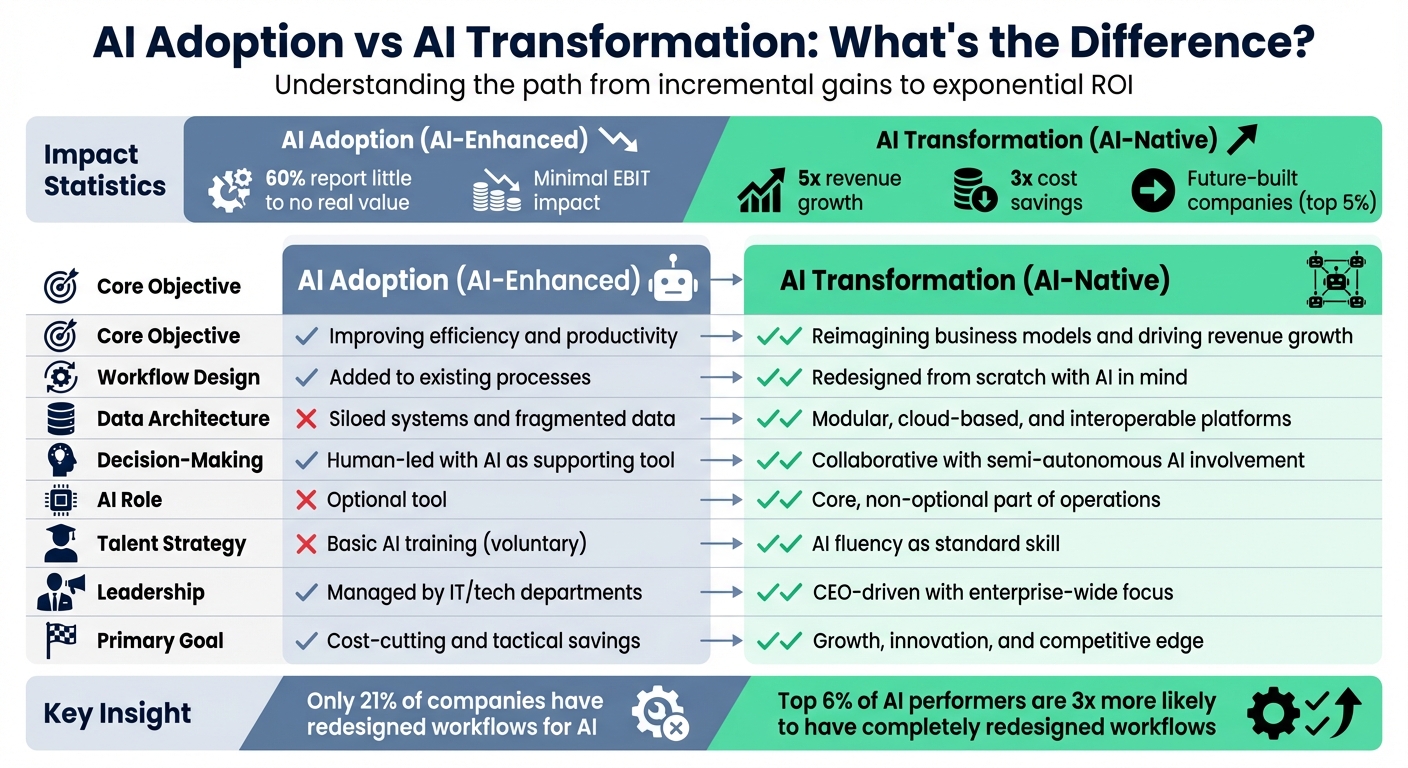
AI Adoption vs AI Transformation: Key Differences and ROI Impact
Side-by-Side Comparison: AI-Enhanced vs. AI-Native
The distinction between AI adoption and AI transformation lies in how deeply AI is integrated into a company’s operations. While some organizations simply layer AI tools onto existing systems, others rebuild their processes entirely around AI capabilities. Here's a breakdown of how these approaches differ:
| Dimension | AI Adoption (AI-Enhanced) | AI Transformation (AI-Native) |
|---|---|---|
| Core Objective | Focused on improving efficiency and productivity | Aimed at reimagining business models and driving revenue growth |
| Workflow Design | Added to existing processes | Redesigned from scratch with AI in mind |
| Data Architecture | Relies on siloed systems and fragmented data | Built on modular, cloud-based, and interoperable platforms |
| Decision-Making | Led by humans with AI as a supporting tool | Collaborative decision-making with semi-autonomous AI involvement |
| AI Role | Treated as an optional tool | Considered a core, non-optional part of operations |
| Talent Strategy | Encourages basic AI training on a voluntary basis | Requires AI fluency as a standard skill |
| Leadership | Managed by IT or tech departments | Driven by CEOs with enterprise-wide focus |
| Primary Goal | Geared toward cost-cutting and tactical savings | Focused on growth, innovation, and gaining a competitive edge |
The impact of these differences is evident in the outcomes. Companies that excel in AI - representing the top 6% - are three times more likely to have completely redesigned workflows. Shopify’s CEO Tobi Lütke demonstrated this shift in April 2025 by requiring employees to integrate AI into their daily tasks. Teams now need to justify why AI can't handle a task before requesting additional staff.
Data architecture is another key differentiator. While AI-enhanced companies often work with disconnected systems, AI-native organizations create integrated, modular setups. This approach allowed a major bank in 2025 to reduce campaign launch times from 60–100 days to just one day.
Common Obstacles to Transformation
Despite its advantages, AI transformation comes with challenges. One of the biggest is resistance to change, often driven by fear of job replacement. Employees may hesitate to document processes or label data, believing they are training an AI to take over their roles. This creates what’s known as the "training trap", where those with the most expertise are the least willing to share it.
Another challenge is low AI literacy. Less than 25% of AI learning happens during work hours, leaving employees to upskill on their own time. Without structured programs and dedicated time, over 85% of employees remain stuck in basic AI use - like providing information or completing simple tasks - while fewer than 10% progress to advanced collaboration with AI, which is essential for transformation.
Leadership support is also critical but often lacking. Only 10% of organizations have their CEO leading the AI strategy. Without top-down commitment, transformation efforts tend to stall. As Boston Consulting Group points out:
"AI transformation is an all-hands-on-deck endeavor... Boards must elevate AI from a digital side project to a core performance agenda, tied explicitly to growth, cost, and productivity outcomes".
Organizational hierarchies can further complicate matters. AI transformation may empower junior employees with advanced AI skills to outperform senior staff, leading to resource hoarding or resistance from those trying to protect their roles. For example, at Dingdong Maicai, an e-commerce company in China, AI systems initially caused friction by pinpointing departmental inefficiencies, forcing the company to reintroduce human oversight.
Why Transformation Produces Better ROI
Despite these hurdles, the benefits of AI transformation far exceed those of simple adoption. By redesigning workflows and data systems, companies can achieve exponential returns. Businesses that embrace transformation see five times the revenue growth and three times the cost savings compared to those focusing solely on adoption.
Adoption tends to optimize existing processes for modest improvements, while transformation reimagines workflows for dramatic gains. The difference is clear: although 88% of organizations report using AI regularly, only 39% see enterprise-level EBIT impact.
Workflow redesign is a critical factor in achieving meaningful ROI. Yet, only 21% of companies have taken this step. Failing to redesign processes often results in minor gains that barely affect the bottom line. As Bain & Company explains:
"ROI comes from reimagining how work gets done and how a company competes. And that requires something deeper: business redesign with AI at the core".
High-performing companies use AI not just to reduce costs but to fuel growth and innovation. For example, Johnson & Johnson initially launched 900 AI projects but later focused on the top 10–15% that delivered 80% of measurable value. These included AI sales tools and predictive models for drug discovery.
Finally, the timeline for ROI is different with AI transformation. While traditional tech investments often pay off in 7–12 months, AI initiatives can take 2–4 years due to the deep changes required. Companies that treat AI like standard software deployments frequently abandon projects too early, which is why 95% of generative AI pilots fail to scale. Transformation, however, delivers compounding returns that adoption alone cannot match.
How to Move from Adoption to Transformation
Leadership and AI Literacy
True transformation starts at the top. When CEOs and business leaders - not just IT departments - take ownership of AI initiatives, the results are far more impactful. A helpful mindset to adopt is the "zero‐based" approach: ask yourself, "If we rebuilt this process today using AI, what would perfection look like in three years?"
For board members, AI fluency is no longer optional. Directors need enough understanding to critically assess management decisions and distinguish between real opportunities and overhyped promises. As BCG aptly states:
"Boards that lead begin with ambition, not algorithms. They are guided by a clear and powerful mantra: impact before technology, targets before tools, discipline before hype."
When allocating resources, follow the 10–20–70 rule: dedicate 10% to algorithms, 20% to technology and data, and 70% to people and processes. This approach ensures the focus stays on what truly drives transformation.
Frontline managers also play a key role by carving out time for their teams to learn and experiment with AI. Since less than 25% of AI learning happens during regular work hours, leaders must actively support this process. DBS Bank exemplifies this by aiming for 1,000 AI experiments annually and using the PURE framework (Purposeful, Unsurprising, Respectful, Explainable) to guide their innovation efforts. By 2024, these initiatives helped the bank double its AI-driven economic impact from S$150 million to S$370 million.
Once leadership sets the tone and upskilling is underway, the next step is embedding AI into every layer of workflows.
Workflow Redesign and Integration
To fully integrate AI, workflows need to be reimagined across three levels: Node (individual tasks), Edge (cross-functional collaboration), and Network (system-wide coordination). AI can take over specific tasks at the Node level, enable better collaboration across departments at the Edge, and ensure that improvements in one area don’t create bottlenecks elsewhere at the Network level.
A great example of this is Guardian Life Insurance. In 2024, their disability underwriting team introduced a generative AI tool to summarize documentation, saving underwriters an average of five hours per day. However, true transformation doesn’t come from simply adding AI tools to existing processes - it requires rethinking workflows entirely to align with AI capabilities.
Instead of spreading resources thin across scattered pilots, focus on 4–5 high-impact domains - clusters of related use cases that can drive competitive advantage. Shopify’s CEO, Tobi Lütke, embraced this strategy in 2025 by requiring employees to prove why AI couldn’t handle a task before requesting additional headcount. This policy pushed teams to design work with AI at its core.
Leaders can also set ambitious goals to challenge outdated processes. For instance, mandating that a week-long task be completed in a single day forces teams to rethink workflows with AI integration in mind. Encouraging data sharing by rewarding teams for turning proprietary datasets into reusable assets on a central platform also helps break down the silos that often hinder transformation.
Building Continuous Learning Systems
Sustaining transformation goes beyond leadership and workflow redesign - it requires systems that continuously evolve and adapt alongside your AI strategy.
Continuous learning thrives on structured experimentation, not isolated pilots. In 2024, Italgas Group launched the "Italgas Academy", delivering over 30,000 hours of AI and data training. They also created a "Digital Factory" where 18 cross-functional teams developed minimum viable products in four-month sprints, each sponsored by a C-level executive. This approach ensures that learning builds over time rather than fading after initial pilots.
To measure progress, establish feedback loops that focus on outcomes like productivity gains, faster cycle times, and improved quality - not just tool adoption. For example, Guardian Life Insurance’s AI-powered RFP process cut proposal timelines from 5–7 days to just 24 hours, with plans to scale this system across the organization.
Another effective strategy is creating "second-opinion consoles", which allow employees to consult AI privately without fear of appearing incompetent. This helps address the common fear of "training their own replacements." Pairing these consoles with credible reskilling programs or productivity bonuses can further build trust and confidence.
Since only 30% of AI pilots successfully scale, adopting a "two‐speed" model can help balance daily operations ("Run") with transformational efforts ("Change"). Embedding business translators - people who connect technical AI expertise with domain-specific knowledge - can also bridge gaps and ensure smoother transitions.
For companies navigating this journey, HRbrain offers tailored solutions. Their 5-day ROI Reset Sprint evaluates AI spending, identifies areas where adoption is high but transformation lags, and delivers a 30-day plan to redesign and launch one workflow with clear KPIs. Their 3-week Workflow Transformation Sprint takes this further by redesigning two workflows with detailed implementation guides, operating playbooks, and adoption systems - turning AI investments into measurable results.
Conclusion: Choosing the Path to AI ROI
The analysis is clear: simply adding AI tools to existing workflows won't yield the game-changing ROI many businesses hope for. Companies that take this incremental approach often see minor efficiency boosts, but these rarely translate into significant financial gains. On the other hand, organizations that fully redesign their operations with AI at the core - what some call "future-built" companies - achieve 5x the revenue growth and 3x the cost savings compared to those stuck in the adoption phase. These numbers highlight the transformative power of rethinking processes through an AI-first lens.
The distinction lies in mindset. AI adoption focuses on speeding up tasks, asking, "How can we make this faster with AI?" Transformation, however, takes a bolder approach, asking, "If we were to rebuild this process from scratch, how would it look in its best form?" This shift - from incremental improvements to complete reimagination - separates the 39% of companies seeing measurable EBIT gains from the 60% that struggle to generate meaningful value despite hefty AI investments.
"The winners won't have the most pilots, the flashiest demos, or the biggest technology budgets. They'll be making strategic choices, combined with the operational rigor to follow through."
- Bain & Company
To bridge the gap, businesses must evaluate their AI strategies critically. Are efforts focused on a few high-impact areas? Is leadership, including the CEO, actively driving these initiatives? Are results measured by tangible P&L outcomes rather than superficial metrics like tool adoption rates?
For companies serious about closing the ROI gap, HRbrain offers actionable solutions. Their 5-day ROI Reset Sprint ($9,500–$12,500) provides a quick audit of your AI investments, delivering recommendations on what to stop, start, or scale. It also includes a 30-day plan to implement a redesigned workflow with defined KPIs and clear accountability. For a deeper dive, their 3-week Workflow Transformation Sprint ($18,000–$28,000) focuses on end-to-end redesign of two workflows, complete with implementation guides, operating playbooks, and adoption frameworks your team can execute immediately. This transition from simple adoption to full transformation is the key to unlocking measurable returns on your AI investment. It’s not just about investing in AI - it’s about ensuring that investment drives real results.
FAQs
What’s the difference between adopting AI and transforming with AI?
AI adoption refers to bringing AI tools - like chatbots or analytics assistants - into your business operations. It’s about encouraging employees to use these tools for tasks or decision-making. However, this approach often stops short of making a real impact. Without rethinking workflows or deeply integrating AI into daily operations, the effect on key metrics, such as revenue or efficiency, tends to be limited.
AI transformation, however, takes things further. It’s not just about using AI; it’s about reshaping how a company operates. This means redesigning workflows, redefining employee roles, and embedding AI into the core of the business model. By aligning AI tools with clear business goals and performance metrics, companies can achieve tangible outcomes, such as increased growth, reduced costs, or new opportunities for innovation.
The reality is that many businesses invest billions in AI but fail to see meaningful returns. Why? Because they focus on adopting tools rather than transforming processes. HRbrain addresses this challenge by helping companies overhaul workflows, set strategic objectives, and turn AI investments into measurable successes.
Why do many companies struggle to see ROI from AI investments?
Many businesses find it challenging to achieve a return on investment (ROI) from AI. Why? Because they often focus on acquiring tools instead of rethinking their workflows and systems. Without reworking processes, assigning clear responsibilities, and tackling internal challenges, AI projects tend to stall in the experimental phase, falling short of delivering measurable benefits.
To see real progress, companies need to do more than just adopt AI technologies. The key lies in weaving AI into their core operations, setting specific objectives, and ensuring their teams have the skills and knowledge to use these tools effectively. This strategy helps transform AI investments into tangible results.
What’s the difference between adopting AI and transforming with AI, and how can businesses make the shift?
Adopting AI involves using specific tools or technologies to handle particular tasks. On the other hand, transforming with AI means embedding these tools deeply into your business operations to drive measurable improvements. The real challenge - and opportunity - lies in moving beyond isolated experiments and rethinking workflows and processes to fully tap into AI's potential.
Here’s how businesses can make this shift:
- Set clear goals: Focus on measurable outcomes, such as boosting growth, cutting costs, or improving productivity.
- Rethink processes: Incorporate AI into core decision-making and daily operations, ensuring workflows are optimized for automation and advanced analytics.
- Start small, then scale: Launch pilot projects with high-impact potential, monitor results using clear KPIs, and expand successful initiatives across the organization.
HRbrain supports businesses by pinpointing areas where AI adoption is happening but deeper transformation is needed. They help redesign workflows and establish accountability systems, ensuring AI investments translate into tangible returns. By aligning people, processes, and technology, companies can unlock sustainable growth powered by AI.